
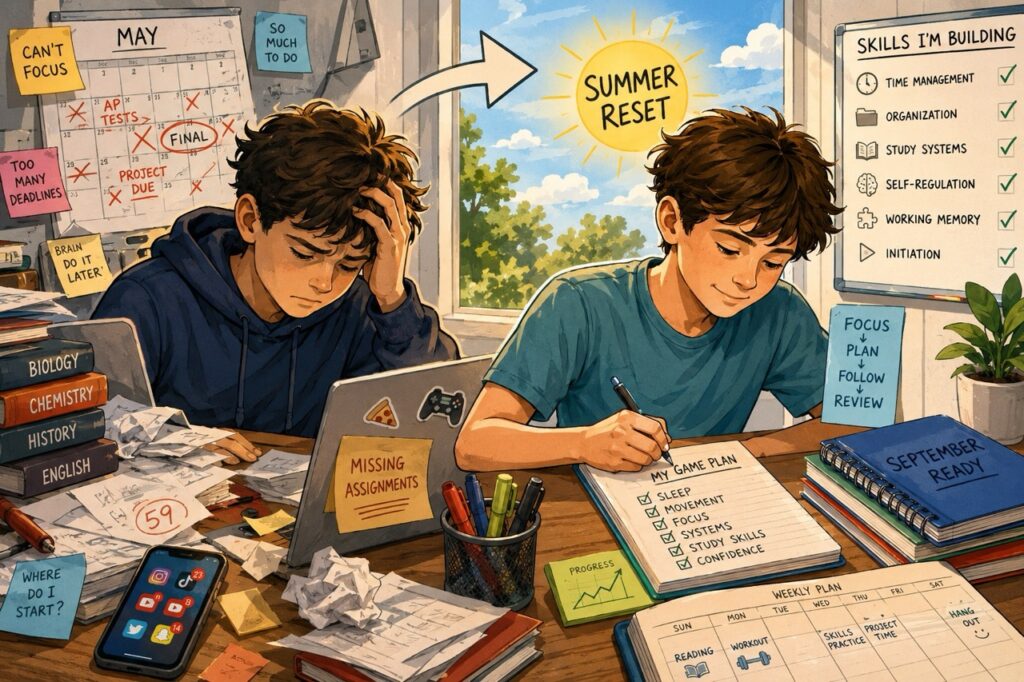
Most parents of ADHD students hit the same realization sometime in May. This year is not going to end strong. The grades will be what they are. The systems that broke in February are still broken. The phone is still winning. September is two empty months away, and you can already see exactly what it will look like if nothing changes between now and then.
If you read last month’s post on why ADHD students shut down in May, this is the follow-up question every parent of an ADHD teen is asking right now: what do we actually do about it?
The choice is not between doing nothing and sending your kid to school all summer. There is a third path. Here is what it looks like, why summer is the only window where it works, and how to do it without making your house a war zone in July.
Why does May break ADHD students so consistently?
May breaks ADHD students because cumulative executive function fatigue, reduced school structure, and cognitive overload from competing deadlines all converge at once. The same systems that held in October cannot hold in May, and the student running them is running on fumes.
The shutdown your teen is in right now is predictable. We covered the diagnostic in detail in last month’s post (“Why Your ADHD Student Shuts Down in May”), and if you have not read it yet, that is the right place to start.
Predictable is the important word. A predictable pattern is also a preventable one. The work this summer is to make next May land differently.
Why is summer the only real intervention window for ADHD students?
Executive function skills cannot be taught well during the school year. There is no time. The student is exhausted. The stakes are too high for the kind of low-pressure practice these skills actually require.
Think about it from the student’s perspective. In March, you cannot ask an ADHD student to slow down and rebuild their planner system. Slowing down means falling further behind. The classes keep moving. The grade tied to every late assignment is real. Trying to teach time management while a student is drowning in time-management failures rarely works.
Summer takes the stakes out. The student is not behind. There is no Friday quiz. There is room for the messy, slow, often-frustrating process of learning a skill before being asked to perform it. That window opens once a year, between June and August, and it closes when school starts.
What are the three options most ADHD families consider for summer?
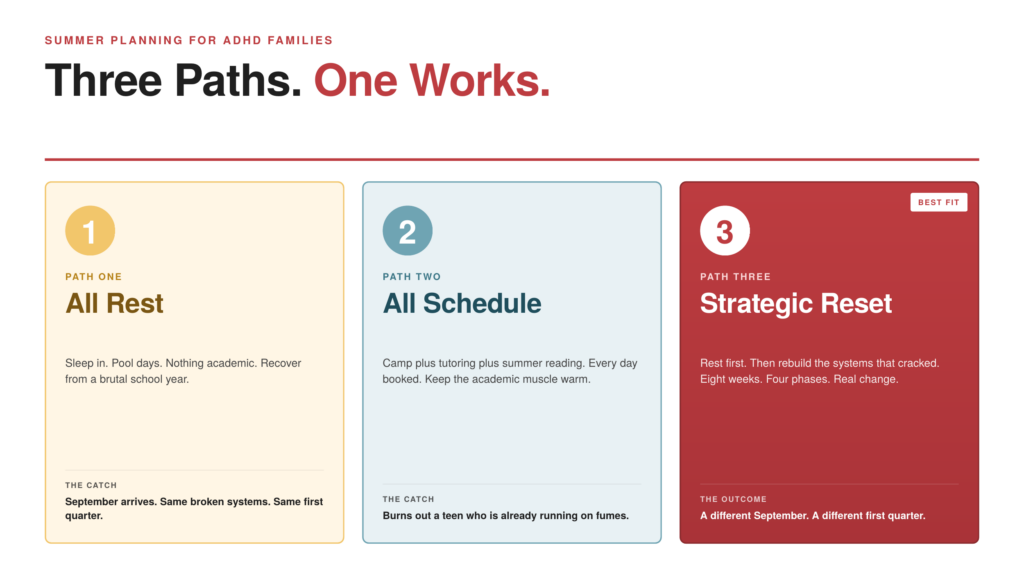
Most parents end up choosing between full rest, a full schedule, or some version of strategic skill-building. Each has tradeoffs.
| Approach | What It Does Well | What It Misses |
|---|---|---|
| Full rest (no academic work) | Restores depleted attention, repairs sleep, lowers family tension | September arrives with the same broken systems that cracked in May |
| Full schedule (camp + tutoring + homework) | Keeps the academic muscle warm, holds structure, prevents the long slide | Burns out an already-exhausted student, recreates school stress in July |
| Strategic skill-building (the 8-week plan) | Rests first, then rebuilds the executive function systems that broke this year, on low-stakes summer material | Requires intentionality from parents and a willingness from the student |
The third path is the one most ADHD families do not consider, because it does not look like either of the obvious options. It is also the one that consistently changes how September looks.
What is the 8-week summer reset plan for ADHD students?
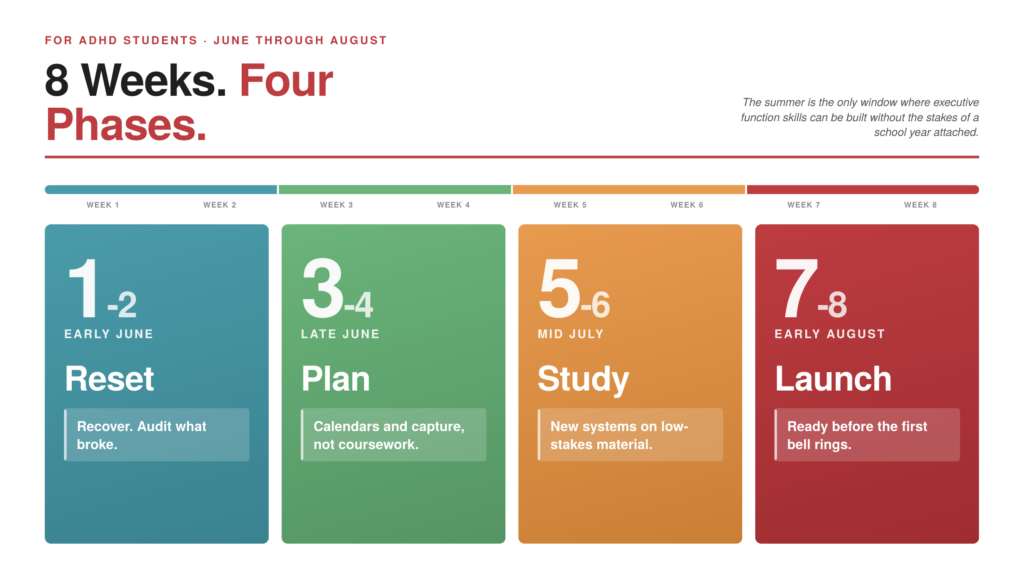
The 8-week reset plan is four 2-week phases that rest first, then rebuild the executive function systems that broke this year, then ramp up before September. It is designed to be low-stakes and parent-supported, not a second school year crammed into July.
Here is the structure.
Weeks 1-2 (early to mid June): Decompression and audit
Pure rest. Sleep. Time outside. No academic work. The only structured task in these two weeks is a parent-led Executive Function audit done with your teen: which executive function skills broke this year, and which ones held? Time management? Initiation? Working memory? Emotional regulation? Sustained attention?
The audit is the entire foundation of the summer. Without it, the rest of the plan is generic. With it, the summer has a target.
Weeks 3-4 (late June to early July): Planning systems
Build the planning systems your teen will use in September. Calendar systems. Capture systems. A Sunday-night review ritual. The trick is to practice these on real summer life, not on schoolwork: camp schedules, family trips, summer reading, social plans.
Most ADHD students will refuse to do “summer school.” Most ADHD students will engage with “let’s get your phone calendar working so I stop nagging you,” because the latter improves their life, not just their grades.
Weeks 5-6 (mid to late July): Study systems
Pick a note-taking method (Cornell or mind mapping; see our May 3 post). Introduce spaced practice. Establish AI use protocols so your teen knows when ChatGPT helps and when it hurts. Practice on summer reading or summer math, not on stakes-heavy material.
Weeks 7-8 (early to mid August): Ramp-up
Use the new systems on real coursework. Preview material from the upcoming year. Organize binders. Set up digital systems for the new school year. The August Essential Study Skills Workshop slots naturally into these two weeks for students who want a structured group experience to anchor the ramp-up.

The full plan, including the Week 1 EF Audit your teen actually fills out, is in the downloadable PDF above. Print it, sit down with your teen sometime in early June, and let the answers shape the rest of the summer.
What if my ADHD teen refuses to do anything academic over the summer?
This is the most common parent fear, and the framework is built around it. Weeks 1-2 are pure rest. Weeks 3-4 are about life systems, not schoolwork. The student does not encounter academic content until week 5, and even then on summer reading rather than fall coursework.
Most ADHD teens who would refuse “summer school” will engage with a calendar that works, a phone that does not bury them in notifications, and a parent who is not nagging them about dishes for the third time this week. The first six weeks of the plan are framed entirely in those terms. By the time you reach the academic work in August, the student usually wants the structure, because they have spent six weeks building the systems and feeling them work.
How do parents make this work without becoming the police again?
Your role over the summer is facilitator, not enforcer. Set up the audit conversation in Week 1. After that, step back. Weekly check-ins, not daily monitoring.
If the parent-teen dynamic is too charged for you to be the EF teacher, hire a coach. Most parents are too charged for this role. That is normal, not a failure. Teenagers who roll their eyes at a parent will sit with a coach because the relational stakes are different. We see this every summer.
Two principles that help most.
- Body doubling. ADHD brains do hard tasks more easily with another person quietly present, doing their own work in the same room. This is a real intervention, not a vibe.
- One weekly check-in. Pick a time (Sunday at 7, for example). Twenty minutes. Review the week, plan the next one, then leave it alone.
What summer programs does S4 offer for ADHD students?
We offer three summer programs that map to different family situations.
- 1:1 Executive Function Coaching. Flexible, fully customized to your teen, runs any number of weeks. Best for families who want the 8-week plan implemented with professional support and a coach holding the relational weight instead of you.
- Crash Course in Study Skills for College. For rising college freshmen with ADHD who need a system before they leave home in August. Intensive, structured, designed for the specific transition.
- Essential Study Skills & Executive Function Workshop. Group format, 3 sessions in August (Middle School and High School versions). $395. Best for students who do well in a group, want a structured ramp-up, and benefit from peers doing the same work.
If you are not sure which program fits your family, that is a 15-minute call worth having.
📞 Call us at 203-307-5455.
Frequently Asked Questions
Should my ADHD teen do summer school or summer tutoring?
It depends what you are trying to fix. Summer school remediates a specific class your teen failed or fell behind in, and it is the right call when that is the problem. Summer tutoring fills subject-matter gaps. Neither rebuilds the executive function systems that caused the gap in the first place. If your teen passed their classes but barely held it together to get there, executive function coaching is usually the better choice.
How many hours per week should an ADHD student work academically over the summer?
Weeks 1-2: zero hours. Weeks 3-4: about 2-3 hours per week on life systems, not schoolwork. Weeks 5-6: about 3-5 hours per week, mostly summer reading or summer math practice. Weeks 7-8: 5-7 hours per week as you ramp into fall. The total is far less than a summer course, and the focus is consistency, not volume.
My ADHD teen needs a real break. Is the 8-week plan too much?
The first two weeks of the plan are pure rest, by design. The plan assumes your teen finished the school year depleted, because most do. The skill-building does not start until your teen has had time to recover. If your family needs the rest period to be three weeks rather than two, stretch it. The framework is a structure, not a contract.
Can executive function skills really be built in 8 weeks?
Eight weeks is enough to install the systems and practice them on low-stakes summer material so they hold when school starts. Eight weeks is not enough to fully internalize executive function as a permanent trait, which takes years of practice and life experience. The realistic outcome is a student who arrives in September with a working calendar, a note-taking method they have actually used, and a Sunday review ritual that is two months old instead of two days old. That is the difference between a September that works and a September that does not.
What is the difference between executive function coaching and tutoring?
Tutoring teaches the content of a class. Executive function coaching teaches the systems and skills the student uses across every class: time management, organization, planning, initiation, working memory strategies, and self-monitoring. A student can be a strong tutoring candidate and a strong EF coaching candidate at the same time. Many of our students do both.
Is the August Essential Study Skills Workshop the same thing as 1:1 coaching?
No. The workshop is a 3-session group program in August that covers the core study skills and executive function strategies every middle or high school student needs. 1:1 coaching is fully customized and ongoing. The workshop is a strong ramp-up for many students. 1:1 coaching is the right call for students who need deeper personalization, accountability, or a longer runway than 3 sessions provide.
Save it for early June. Print it. Sit down with your teen and walk through the EF audit together. That one conversation is the difference between a summer that drifts and a summer that builds.
Local Resources for Fairfield County and Westchester Families
S4 Study Skills supports ADHD students and their families across Fairfield County, CT and Westchester County, NY, including Greenwich, Darien, Westport, New Canaan, Southport, Armonk, Scarsdale, and Chappaqua. We work 1:1 with students year-round and offer structured summer programming designed specifically for ADHD learners.

