

Every spring, parents describe the same pattern to us. Their ADHD student held it together through the fall. They pushed through midterms. They survived the winter grind. And then somewhere around mid-April, the wheels come off.
Grades start slipping. Assignments go missing. The motivation that was barely holding on disappears. Conversations about school become arguments or silence. The student who seemed to be making progress three months ago now looks like they’ve given up entirely.
If you’re watching this happen in your household right now, there’s something important to understand: your student hasn’t stopped caring. Their executive function tank is empty.
May is the most executive-function-intensive month of the school year. Finals, projects, presentations, makeup work, and end-of-year deadlines all converge at the exact moment your student’s cognitive reserves are at their lowest. For students with ADHD, this convergence doesn’t just create stress. It creates a shutdown.
At S4 Study Skills, we work with ADHD students across Darien, Greenwich, Scarsdale, and Chappaqua who face this pattern every year. The strategies below are what actually help, and not generic advice about trying harder, but specific executive function interventions that account for how the ADHD brain works under pressure.
What Does the End-of-Year Executive Function Breakdown Look Like?
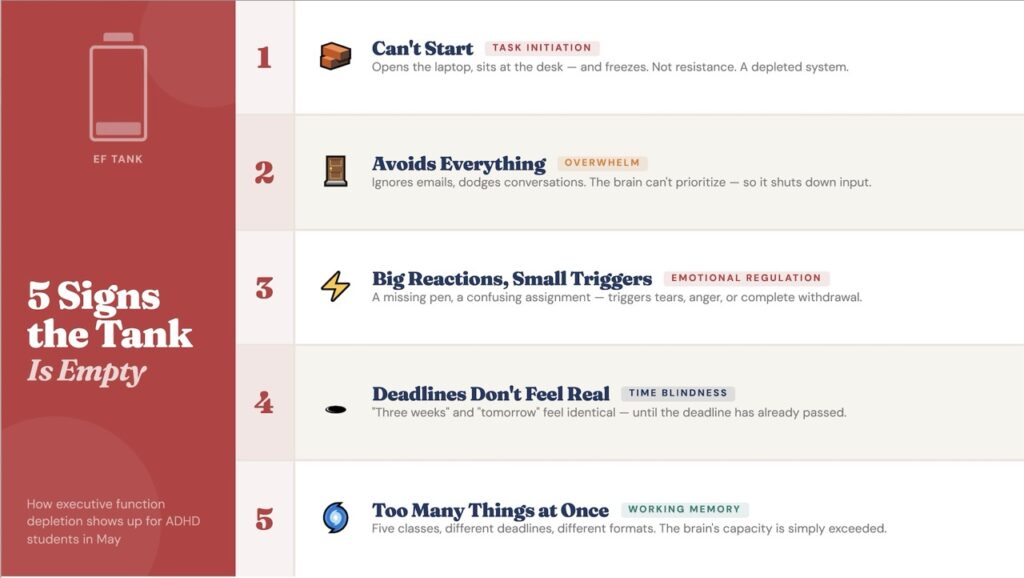
The May shutdown in ADHD students is a predictable pattern driven by executive function depletion. It typically shows up in one or more of these ways:
- Task initiation collapses. Your student knows they have work to do, but physically cannot start. They sit at their desk, open their laptop, and then freeze. Don’t take it as laziness, as it’s a depleted task initiation system that has been running on fumes since February.
- Avoidance intensifies. They dodge conversations about grades, ignore teacher emails, and “forget” about assignments. Avoidance is an ADHD coping mechanism for overwhelm. When the brain can’t prioritize, it shuts down input entirely.
- Emotional regulation breaks down. Small frustrations trigger disproportionate reactions. A missing pen, a confusing assignment, a parent asking about homework. Any of these can trigger tears, anger, or complete withdrawal.
- Time blindness worsens. The ADHD brain already struggles with time perception. Under end-of-year stress, the gap between “I have three weeks” and “the final is tomorrow” collapses. Students genuinely don’t register how close deadlines are until they’ve passed.
- Working memory overload. Five classes, each with different deadlines, different formats, and different requirements. For a brain that already struggles to hold and manipulate multiple pieces of information simultaneously, the May workload exceeds capacity.
If any of these describe your student right now, you’re dealing with an executive function problem. And the fix looks different from what most parents try first.
Why Does May Hit ADHD Students Harder Than Everyone Else?
Students with ADHD are operating with an executive function system that develops 2–3 years behind their peers. A 16-year-old with ADHD may have the executive function maturity of a 13- or 14-year-old. That gap is manageable when the demands are moderate. It becomes unmanageable when May compresses six weeks of demands into three.
Three factors make May uniquely difficult for the ADHD brain:
- Cumulative fatigue. Executive function is a finite resource. Your student has been compensating for ADHD-related challenges all year, using more mental energy than neurotypical peers just to keep up with basic organizational demands. By May, the reserves are genuinely depleted.
- Competing demands require prioritization. May asks students to juggle finals study, long-term projects, daily homework, test prep, and end-of-year activities simultaneously. Prioritization is one of the weakest executive function skills in ADHD. When everything feels equally urgent, the ADHD brain often chooses nothing.
- Reduced structure from school. Many teachers shift to review mode or independent project time in May, which removes the external structure that ADHD students depend on. Fewer reminders, looser deadlines, and more self-directed work all amplify executive function demands at the worst possible time.
6 Executive Function Strategies That Actually Help in May
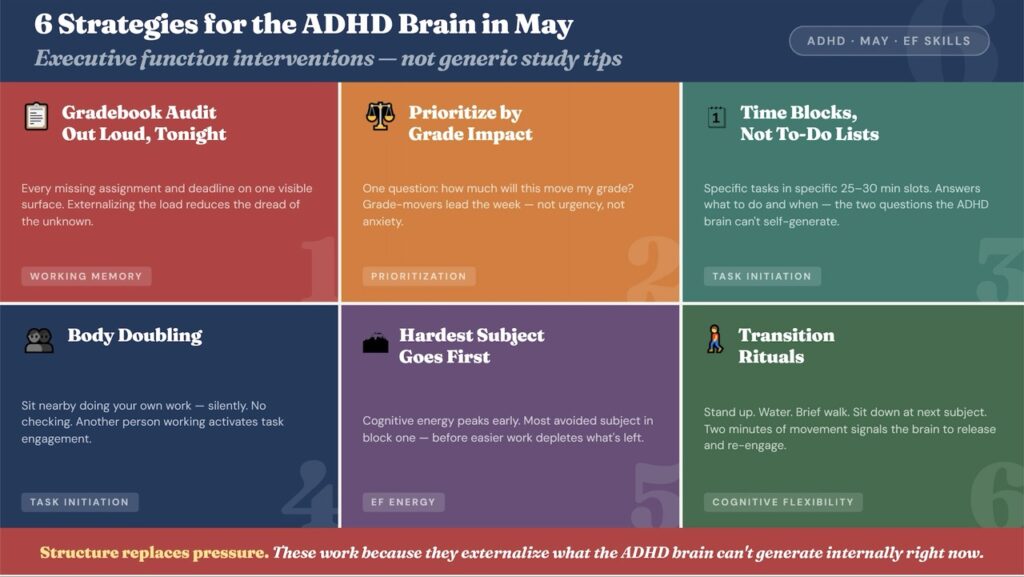
These aren’t generic study tips. These are specific interventions designed for the ADHD brain under end-of-year pressure. Parents can implement most of them at home this week.
-
Do a full gradebook audit. Together, Out Loud, Tonight.
Pull up every class. Write down every missing assignment, upcoming test, and project deadline on a single piece of paper or whiteboard. For ADHD students, the overwhelm is often worse than the reality because they’re dreading an unknown volume of work. Seeing the full picture in one place (externalized, visible, and concrete) reduces the mental load of dreading what they can’t remember.
Most families we work with in Fairfield and Westchester counties are surprised to find the actual workload is smaller than it felt.
-
Prioritize by grade impact, not by due date.
ADHD brains sort tasks by urgency and interest, not by importance. A daily homework assignment due tomorrow will feel more urgent than a final project worth 25% of the grade that’s due in two weeks. Help your student rank every remaining assignment and test by one question: how much will this move my grade?
A missing lab report worth 15% matters infinitely more than a completed daily homework worth 1%. Build the week’s plan around grade-movers, not to-do list volume.
-
Replace the to-do list with time blocks.
To-do lists don’t work for most ADHD brains. They create visual overwhelm without providing structure. Time blocks work because they answer two questions the ADHD brain can’t answer internally: what should I work on? and when should I do it?
The format is simple: assign specific tasks to specific 25–30 minute blocks on a daily schedule. Monday 4:00–4:30: Chemistry review problems 1–10. Monday 4:35–5:00: English essay outline. Write it on a whiteboard or print it as a daily sheet. The external structure replaces the internal planning system that isn’t firing consistently right now.
-
Use body doubling for task initiation.
Body doubling, studying in the same room as a parent, sibling, or friend who is also working, is one of the most effective ADHD strategies for task initiation that most families don’t know about. The presence of another person working creates a subtle social accountability that helps the ADHD brain engage.
This doesn’t mean hovering, helping, or checking their work. It means sitting nearby with your own laptop or book, quietly doing your own thing. Many ADHD students who can’t start working alone in their room will start within minutes if someone else is working nearby.
-
Front-load the hardest subject to the first study block.
ADHD medication, focus, and cognitive energy are all at their highest in the first few hours after school or in the morning. The subject that’s most difficult or most avoided should always go first, not after three easier assignments have depleted what little executive function energy is available.
This is counterintuitive for many students, who prefer to “warm up” with easy work. But for ADHD brains under May-level pressure, the warm-up becomes the whole session, and the hard subject never gets touched.
-
Build in transition rituals between tasks.
ADHD students struggle with cognitive flexibility, the ability to shift from one subject to another. Without a deliberate transition, they either get stuck on the first subject or lose all momentum between switches.
A transition ritual can be as simple as: stand up, get a glass of water, walk to a different room and back, then sit down and open the next subject. Two minutes. The physical movement signals the brain to release the previous task and engage with the new one. Without that signal, the brain stays stuck in a cognitive no-man’s-land.
How Can Parents Help Without Making It Worse?

The biggest mistake parents of ADHD students make in May is increasing pressure when they should be increasing structure. Pressure without structure produces more avoidance, not more action.
What helps:
- Facilitate the gradebook audit and prioritization session, then step back and let them execute
- Offer to be the body double during study blocks (sit nearby, do your own work)
- Protect the evening schedule by reducing non-academic commitments this month
- Validate the difficulty: “This is a hard stretch. Your brain is working overtime. What’s one thing I can take off your plate this week?”
- Ask one check-in question per day (“What did you work on today?”) and accept the answer without follow-up interrogation
What backfires:
- Lecturing about effort, motivation, or the consequences of failing
- Comparing them to siblings or peers who seem to be handling May fine
- Taking over the planning entirely (builds dependence, not skill)
- Removing all activities, social time, and breaks as punishment for falling behind (these are regulatory tools the ADHD brain needs, not luxuries)
The shift we teach at S4 is from Homework Police to Strategic Consultant. A consultant provides the framework, checks in at agreed intervals, and trusts the person to execute. That trust is what builds the independence your student needs, not just for May, but for college and beyond.
When Is It Time to Get Outside Support?
If the end-of-year shutdown is happening for the second or third year in a row, and each spring involves the same cycle of avoidance, panic, and promises that next year will be different, the pattern is telling you something.
Executive function skills don’t develop automatically. Some students need them taught explicitly, the same way some students need math or writing taught explicitly.
Our executive function coaching works directly on the skills that are breaking down right now: task initiation, prioritization, time management, self-monitoring, and cognitive flexibility. We work with students in real time on their actual coursework.
Call us at 203-307-5455. There are still several weeks left in the school year. That’s enough time to make a real difference with the right support in place this week.
And if you’re already thinking about next year, our summer Executive Function Workshop builds these skills without the pressure of grades, so your student walks into September with systems instead of scrambling to build them under fire again.
Frequently Asked Questions
Why does my ADHD student give up at the end of the school year?
End-of-year shutdown is driven by executive function depletion, not lack of motivation. ADHD students use significantly more cognitive energy than neurotypical peers just to meet baseline organizational demands. By May, those reserves are exhausted at the exact moment demands peak.
Is my ADHD teen being lazy, or is this a real executive function issue?
If your student was able to perform earlier in the year but is now struggling despite apparently caring about their grades, you’re almost certainly looking at executive function depletion rather than laziness. The pattern of “capable earlier, shutdown later” is one of the most common ADHD presentations we see.
How do I help my ADHD child study for finals?
Start with a gradebook audit to identify where effort will have the most impact. Use time blocks instead of to-do lists. Front-load the hardest subject. Use body doubling. Keep sessions to 25–30 minutes, and protect sleep, as cognitive performance drops sharply without it, and ADHD students are already operating with reduced executive function capacity.
What’s the difference between executive function coaching and tutoring?
Tutoring addresses content gaps, what your student doesn’t know. Executive function coaching addresses skill gaps in how your student plans, prioritizes, initiates, and manages their work. Many ADHD students don’t have content problems. They have execution problems. We work on the execution.
Can executive function skills be taught, or is my child stuck with this?
Executive function skills absolutely can be taught and strengthened with explicit instruction and practice. Research consistently shows that ADHD students who receive structured EF coaching show measurable improvements in academic performance and daily functioning. The skills that feel impossible now are buildable; they just need to be taught directly rather than assumed to develop on their own.
Should I reduce my ADHD student’s workload in May?
If the current load is causing a genuine shutdown, a strategic reduction is appropriate. Talk with teachers about which assignments carry the most weight and which can be deprioritized. One honest email from your student to a teacher: “What should I focus on to improve my grade?” often opens doors that avoidance keeps closed.
S4 Study Skills provides executive function coaching, ADHD-specialized tutoring, and study skills support for families in Fairfield County (Greenwich, Darien, Westport, New Canaan) and Westchester County (Scarsdale, Chappaqua, Armonk). Call 203-307-5455 to schedule a consultation.

