
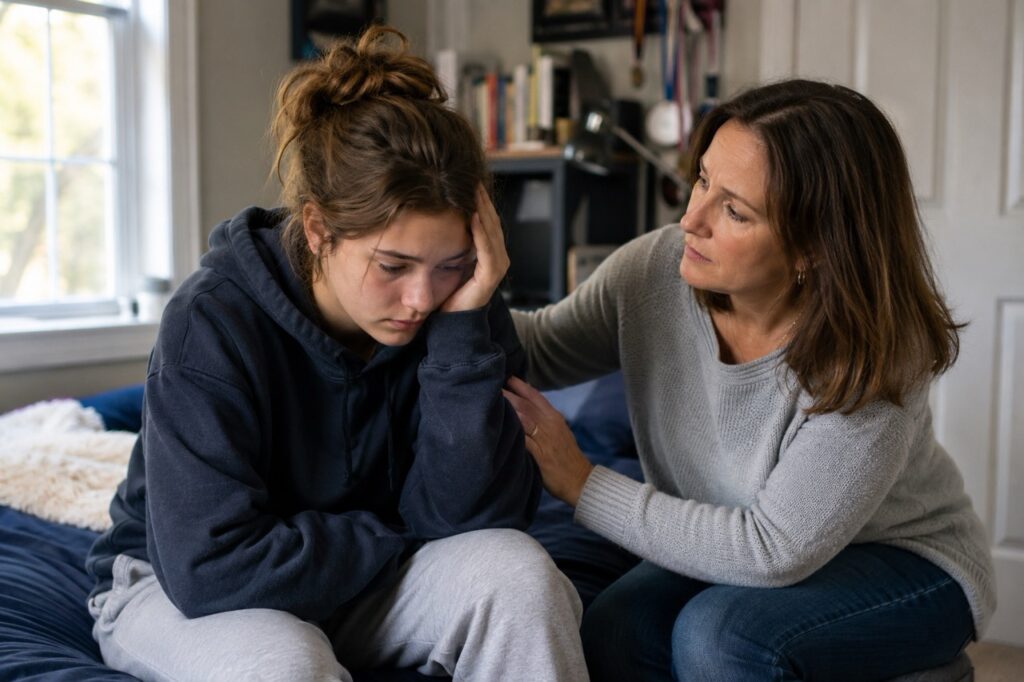
The teenager who used to talk in full sentences answers in one word now. The bedroom door closes earlier. “How was your day?” gets a shrug. Grades are shaky but not catastrophic. The hoodie has been on for three days.
You are quietly asking yourself the question every parent is asking right now: is this just May, or is something actually wrong?
Most spring stress in teenagers is real, normal, and recoverable. Some of it is not. The hard part for parents is knowing which is which without slipping into panic or dismissal.
Here is a practical framework for telling the difference, what to do at each level, and when to bring in outside support.
What is the difference between normal end-of-year stress and a real problem?
Most spring stress in teens is real but recoverable. Sleep dips. Moods shift. Procrastination spikes. Almost none of this, on its own, is a red flag.
The signs that suggest a real problem are not the usual ones. They are the patterns of withdrawal, hopelessness, and persistent change in behavior that do not lift on weekends or during a school break. The question is rarely whether your teen is stressed. It is whether the stress has crossed into territory that needs more than what you can offer at home.
Here is what to look for.
| Behavior | Normal Range | Watch List | Time to Act |
|---|---|---|---|
| Sleep | Some late nights, rough mornings, recovers on weekends | Disrupted sleep most nights for 2+ weeks | Severe insomnia, or sleeping 12+ hours daily for weeks |
| Appetite | Shifts on stress days, evens out | Persistent change for 2+ weeks | Notable weight change, skipping meals consistently, or new rigid rules around food |
| Social | More alone time, lower social energy, still shows up to dinner | Pulling away from close friends, declining invitations they would normally accept | Cutting off friends entirely, isolating from family for days |
| Academics | Procrastinating, complaining, getting it done | Letting things slip that used to matter to them, missing assignments | Stopped trying entirely, hiding grades, refusing to discuss school |
| Mood | Snappy, eye-rolling, irritable, recovers | Sustained irritability, more crying than usual, flatness | Persistent hopelessness, anger that scares you, blunted affect |
| Communication | Shorter answers, less chatty, still present | Avoiding conversations, leaving the room when you enter | Refusing to talk, secretive, lying about whereabouts |
| Talk about school | “I hate this.” “I cannot wait for summer.” | “Nothing I do matters.” “I am so far behind.” | “What is the point.” “It does not matter if I do well.” |
| Talk about self | “I am tired.” “I am stressed.” | “I cannot do anything right.” “Everyone hates me.” | Statements about hopelessness, being a burden, or things not getting better |
If this table was useful, you can save it as a one-page reference card to keep on your phone or pin to the fridge. The download below includes the full comparison table plus a “Who to Call When” guide with space to write in your family’s pediatrician, school counselor, and therapist.

What does normal end-of-year stress look like?
Normal end-of-year stress is loud, exhausting, and visible. It looks like:
- Complaining about teachers, AP exams, and the SATs
- Procrastinating on assignments they used to handle on time
- A desperate countdown to the last day of school
- A few late nights and irritable mornings
- Wanting more alone time but still showing up to dinner
- Being short with siblings and parents
- Eating less or more on stressful days, then evening out
If this sounds like your teen, you are looking at a normal kid having a hard May. Most of this resolves on its own once finals end and the school year closes. What helps most is reducing non-essential commitments and protecting sleep, which we will get to below.
When should I be worried about my teen?
Consider stronger support when behavioral changes persist beyond two or three weeks, when more than one major area of life is affected at the same time (sleep, eating, school, friendships, sense of self), or when your teen says or hints at things that worry you.
Some specific patterns that move from watch list to time-to-act:
- Withdrawal that does not lift on weekends or during a school break
- Sleep changes (much more or much less) lasting more than two weeks
- Loss of interest in things they used to care about, with no replacement interest
- Hopeless or self-critical statements that go beyond complaining about a hard week
- Appetite changes, mood changes, and academic changes happening together
- Talk that suggests your teen feels like a burden, or that things will not get better
If your teen says something that scares you, take it seriously the first time, not the third. You can call your pediatrician, your teen’s school counselor, or 988 (the national Suicide and Crisis Lifeline). You do not need to be sure something is wrong before you make a call. Calling is what the call line is for.
How can I support a stressed teen without making it worse?
The instinct is to push: more conversation, more questions, more advice. With most teenagers, that backfires.
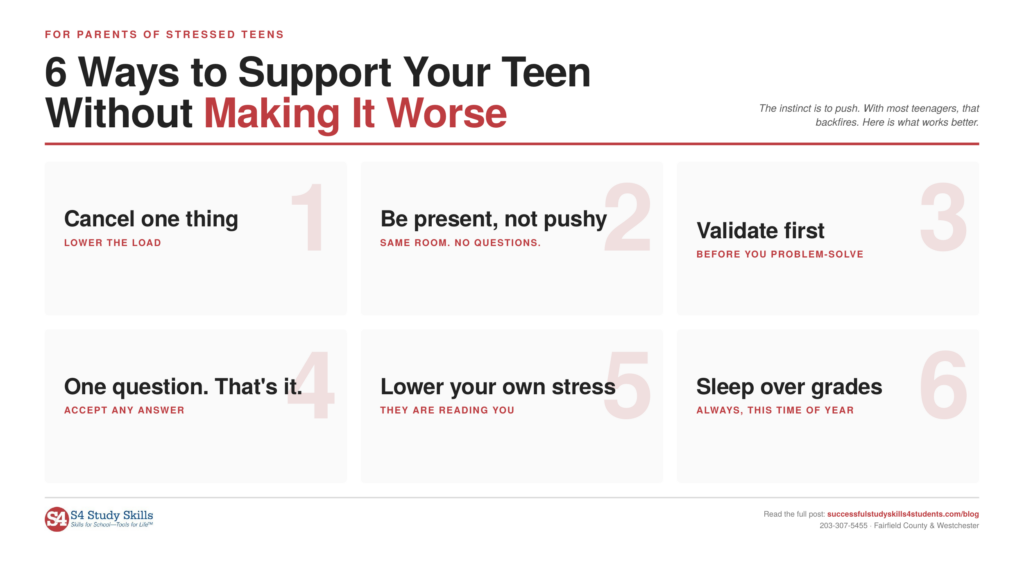
Here is what tends to work better.
- Reduce non-essential commitments. This is not the week for a dentist appointment that could wait or a difficult conversation about the messy room.
- Offer presence without pressure. Sit in the same room. Watch the same show. Ride in the car with the radio on. Closeness without questions is often more useful than another check-in.
- Validate before you problem-solve. “This is a lot. I see it.” goes a long way before any version of “Have you tried…”
- Ask one open question per evening. Not a string of them. Accept whatever answer comes, including no answer.
- Watch your own stress. Teenagers read their parents’ nervous systems faster than they read texts. If you are panicking, they will feel it.
- Protect sleep above grades during high-stress weeks. A B on a test taken after eight hours of sleep is worth more than an A on a test taken after four. The grade gap closes. The sleep deficit compounds.
Most of these are small. None of them require you to fix anything. They lower the temperature in the house, which is sometimes the only thing a stressed teen actually needs.
When is it time to bring in outside support?
There are three different kinds of outside support, and they are not interchangeable.
- Clinical support (therapy, pediatrician). When the issue is mental health: persistent low mood, anxiety that is interfering with daily life, panic, disordered eating, hopelessness, or any direct concern about safety. A therapist or pediatrician is the right first call. An academic coach is not a substitute for clinical care.
- School-based support (school counselor, teacher communication). When the issue is school-specific: a class your teen has fallen too far behind in, a teacher relationship that has broken down, accommodations that are not being honored. The school counselor is often the fastest path to something practical happening this week.
- Academic support (tutoring, executive function coaching). When the issue is partly that your teen is buried under disorganization, weak study systems, or a workload they do not have the tools to manage. Sometimes the academic side is the lever that takes pressure off the emotional side. Sometimes it is not.
For some families, the answer is one of these, for many, it is two, for a few, it is all three.
What does S4 do (and not do) for struggling students?
We do executive function coaching, study skills tutoring, subject-matter tutoring, ADHD support, and SAT/ACT prep. We do not do clinical mental health treatment.
For students whose stress is partly driven by feeling buried under disorganization or a system that is not working, executive function coaching can lift the academic side enough to take meaningful pressure off the emotional side. Less chaos in the binder often means less chaos in the head.
For students whose stress is primarily clinical, we will say so and refer you to local clinicians we trust. Honest answers, not a sales pitch.
If you are not sure which kind of support your family needs right now, that is a 15-minute phone call worth having.
📞 Call us at 203-307-5455.

Frequently Asked Questions
How do I know if my teen is just stressed or actually depressed?
The clearest signal is duration and reach. Stress tends to be loud, episodic, and tied to specific events. Depression tends to be quieter, more pervasive, and present even on days that should be good. If the changes have lasted more than two weeks and touch more than one part of your teen’s life (sleep, eating, social, school, sense of self), that is the point at which a clinician should weigh in. A pediatrician or therapist can make a real assessment. A blog post cannot.
Should I let my teen skip school during finals if they are really overwhelmed?
A single mental health day, used intentionally, is sometimes the right call. A pattern of skipping is not. Talk to your teen’s school counselor before it becomes a pattern. Many schools across Fairfield County and Westchester have policies that distinguish between mental health absences and unexcused absences, and the counselor can walk you through what is allowed at your specific school.
My teen says everything is “fine.” How do I know if it really is?
Watch behavior, not vocabulary. Most teens default to “fine” regardless of what is happening. The signal is whether the rest of their life looks fine: sleep, eating, friendships, time spent in the house with you, energy in their voice on a Tuesday at 6 PM. If those look right, “fine” is probably close to true. If they do not, “fine” is filler.
What is the difference between a school counselor and a therapist?
A school counselor works inside the school and addresses school-specific problems: classes, schedules, peer issues, accommodations, college guidance. A therapist works outside the school, meets weekly or biweekly, and addresses mental health. Both are valuable. They do different jobs, and many teens benefit from having both.
How do I get my teen to talk to me?
Lower the stakes. Stop asking direct questions during the moments your teen feels most observed (right after school, at the dinner table). Try the side-by-side moments instead: in the car, on a walk, while making something in the kitchen. Ask one open question. Accept whatever you get. Try again tomorrow.
Are there teen mental health resources in Fairfield County or Westchester County?
Yes. Most pediatric practices in both counties can refer to local adolescent therapists. The Child Mind Institute (with offices in NY) is a well-regarded clinical resource for adolescents. School counselors at most public and independent schools can provide referrals to local providers. For crisis support, 988 is available 24/7, and some hospital systems in both counties operate adolescent mental health intake lines.
Save this for the next time you need it. We turned the comparison table into a one-page reference card you can keep on your phone or print for the fridge. It also includes the phone tree from this post (pediatrician, school counselor, therapist, 988, S4) with space to write in your family’s specific numbers. Keep it somewhere you will find it before the next conversation that worries you.
Local Resources for Fairfield County and Westchester Families
S4 Study Skills supports families across Fairfield County, CT and Westchester County, NY, including Greenwich, Darien, Westport, New Canaan, Southport, Armonk, Scarsdale, and Chappaqua. We work with stressed students whose academic systems are part of the problem, alongside their clinicians, school counselors, and families. We also keep a referral list of local adolescent therapists and pediatricians for the families that need that conversation first.

