

Quick Answer
Start about two weeks before the test. List every test date, work backward, and place short review sessions across those two weeks. Use active methods such as practice problems and self-quizzing rather than rereading notes. A student who can do the work without notes or AI is ready for a proctored exam.
There is a particular kind of quiet that settles over a house the night before a big test. A door closes, a light stays on too late, and somewhere around 11 p.m. you hear the words “I don’t get any of this.”
Most midterm meltdowns start two weeks earlier, on the day the test date was announced and nothing went on the calendar. The fix is a plan built backward from the test, with a few study methods that actually stick.
Here is how to build one, what to do differently for a student with ADHD, where AI fits, and what to do if the test is days away and nothing has started.
PART 1: The Plan
When should students start studying for midterms?
About two weeks before the test is a good default. That gives enough time to spread review across several short sessions, find the topics that need more work, and still have a calm night before the test.
A few things change the timeline:
- What “midterm” means at your school. Some schools give cumulative semester midterms in January. Others call a big fall unit test or an end-of-quarter exam a midterm. A cumulative exam may need three weeks, while a single unit test may need one.
- How many tests land in the same week. Four tests in five days means each one needs its own start date.
- How your child is doing in the class. A subject that has been a struggle all quarter needs a head start.
If you just read your child’s progress report, this is the natural next step. Our Q1 progress report post covers how to sort out what went wrong first.
What is a backward plan, and how do you build one?
A backward plan starts at the test date and works back to today, placing short study sessions along the way. It turns “study for midterms” into a list of small, specific jobs with dates attached.
Four steps build it:
- List every test. Subject, date, what it covers, and roughly how much it counts.
- Count back. Mark the day two weeks before each test. That is the start date.
- Place the sessions. Spread 20 to 45 minute sessions across those two weeks, with the hardest or heaviest subject getting the most. Put each topic in at least twice, a few days apart.
- Protect the day before. Light review only, then gear packed and an early night. No new material.
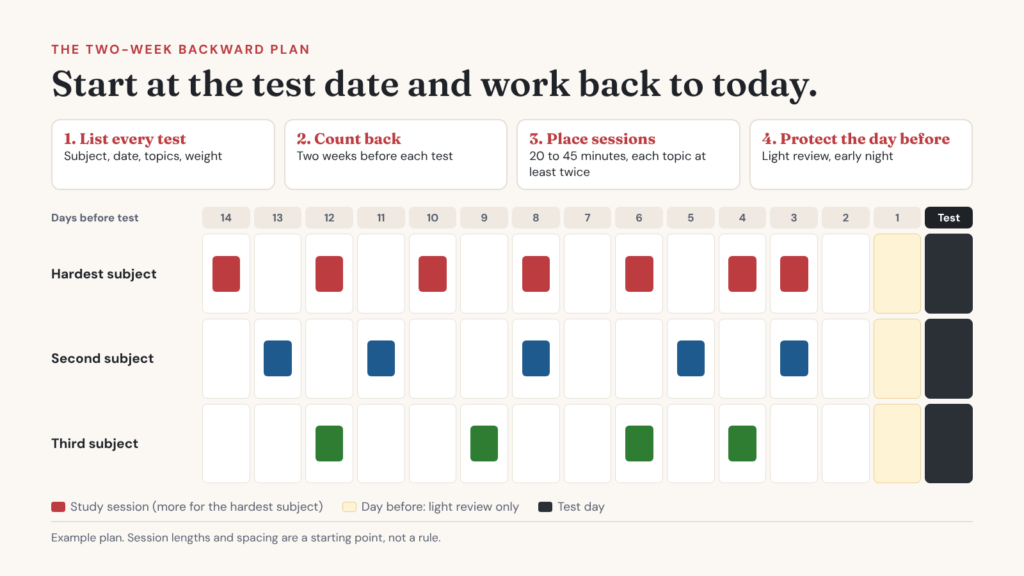
If you have more than one test, build the plan for the earliest one first, then fit the others around it. Writing everything on one calendar makes collisions obvious before they happen.
We made a one-page version with a 14-day calendar for up to four tests, a method picker, and a day-before checklist.

Why does cramming usually fall short?
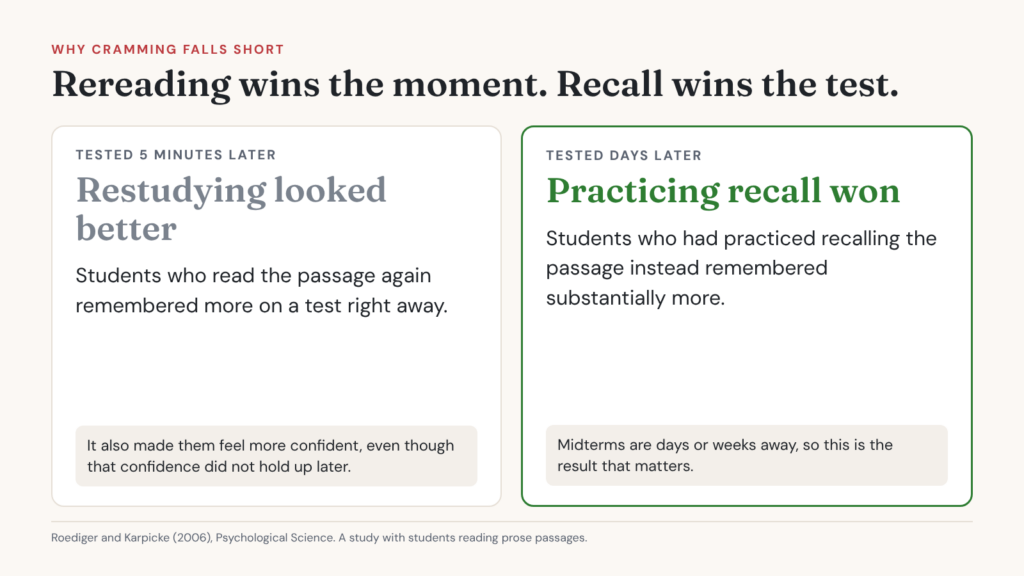
Because cramming builds familiarity, and tests ask for recall. Rereading notes the night before can feel productive, because the material looks familiar. Familiar and remembered are two different things, though, and the gap usually shows up on test day.
Two well-studied ideas explain why spreading study out works better:
- Spacing. A 2013 review of learning research rated distributed practice, meaning study spread across several sessions, as one of the two most useful study techniques it examined. A larger analysis of hundreds of experiments found that the best gap between study sessions grows as the time until the test grows.
- Retrieval. In a 2006 study, students who restudied a passage did better on a test five minutes later. On tests given days later, students who had practiced recalling the material instead remembered substantially more. Restudying also made students feel more confident than their later results justified.
These are lab and classroom studies, and no single study predicts how your child will do on a specific test. Together they point in one clear direction: shorter sessions spread over time, with lots of practice pulling information out of memory, beat one long session of reading it again.
We covered cramming in more depth in Want to do Poorly on Midterms? Do This, and our post on ditching the highlighter walks through three active methods step by step.
Which study methods actually work?
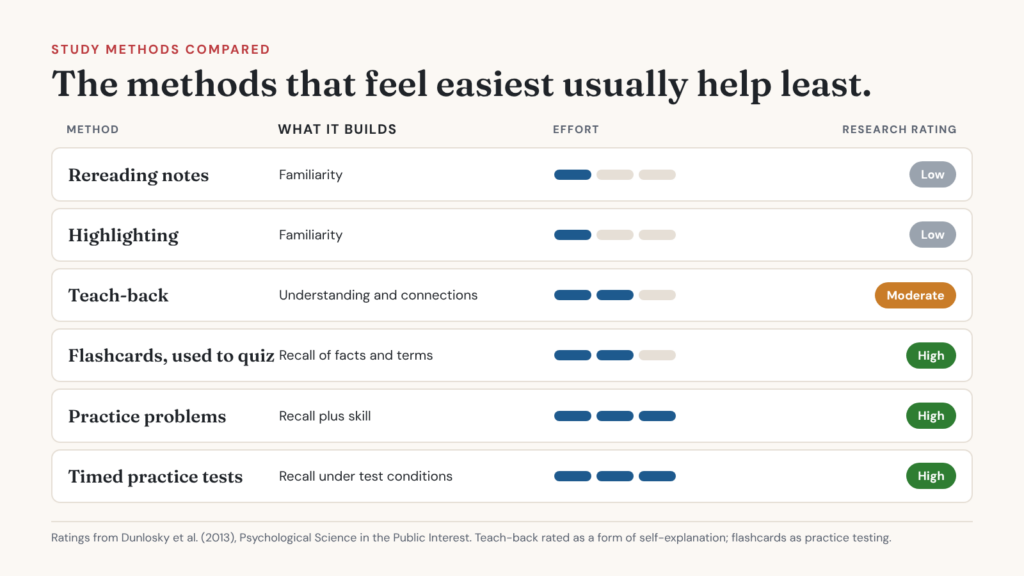
Methods that make your child produce an answer work better than methods that have them reread one. The table below compares six common methods. The research ratings come from the 2013 review above.
Study methods compared
| Method | What it builds | Effort | Best use | Research rating |
| Rereading notes | Familiarity | Low | A quick skim before starting active review | Low |
| Highlighting | Familiarity | Low | Marking what to quiz yourself on later | Low |
| Flashcards, used to quiz | Recall of facts and terms | Medium | Vocabulary, dates, formulas, definitions | High, when used for self-quizzing |
| Practice problems | Recall plus skill | Medium to high | Math, science, grammar, anything with steps | High |
| Teach-back | Understanding and connections | Medium | Big ideas, processes, essay topics | Moderate, as a form of self-explanation |
| Timed practice tests | Recall under test conditions | High | The last few days before the test | High |
A good rule for any session: if your child can do it with the book open, the session should end with the book closed.
PART 2: Adjusting the Plan
How does ADHD or executive function change midterm prep?
The plan stays the same, and the setup around it does more of the work. Students with ADHD or executive function challenges usually know they need to study. Starting, keeping track of time, and switching between subjects are the hard parts, so the plan needs more outside structure.
- Smaller chunks. Fifteen to twenty minutes on one topic, then a short break. A session with a clear finish line is easier to start.
- An external calendar. A paper calendar on the wall or a shared digital one, visible every day. A plan that lives only in your child’s head tends to disappear.
- Start rituals and timers. Same place, same time, same first step, such as opening the practice set and setting a timer. The ritual makes starting automatic.
- Studying alongside someone. Many students find it easier to stay on task with another person working quietly nearby, whether that is a parent paying bills at the same table or a friend on a study call.
- Follow the plan’s accommodations. If your child has an IEP or 504 plan with accommodations such as extended time or a separate testing room, confirm with the school that they are in place for midterms, and practice with the same conditions at home.
Our post on midterm study hacks for students with ADHD has more ideas, and our two-track framework for midterms breaks down the executive function skills that matter most under test pressure. If your child is preparing for several big exams at once later in the year, our guide to studying for multiple AP exams without burning out uses the same approach.
When planning, starting and keeping track of study time are the real obstacle, executive function coaching works on exactly those skills.
Can AI help with midterm review?
Yes, as a quizzer and as a second explanation, as long as your child does the answering. Two uses fit midterm review especially well:
- Quizzing from their own notes. Your child pastes in class notes and asks to be quizzed one question at a time, answering before the tool says whether they were right.
- A second explanation. When a concept from early in the quarter never clicked, a different explanation, followed by practice without the tool, can close the gap.
A proctored test is where help-dependent work shows up. Nobody brings a chatbot into the exam room, so any understanding that lived in the tool stays behind. That is the payoff of the two posts we wrote earlier this fall. Did My Kid Use AI on That? covers the ninety-second comprehension check, and What Good AI Use Actually Looks Like, Grade by Grade lays out the line: middle schoolers should produce everything themselves after an explanation, and juniors and seniors can use AI for research support and revision as long as they can defend every claim with the tool closed.
The simplest readiness test is the same one: can your child do the work with the notes and the AI closed? If yes, they are ready. If not, that is where the next study session goes.
How can parents help without taking over?
Provide the structure, then let your child run the plan. Parents are most useful setting up the conditions for studying. The studying itself belongs to your child.
- Provide the calendar. Print the backward plan, hang it somewhere visible, and help fill in the test dates the first time.
- Provide a quiet space. A clear table, phones in another room, and a predictable time.
- Ask about the plan. “What’s your plan for chemistry this week?” opens a conversation. “Did you study?” usually gets a one-word answer.
- Protect sleep. Help hold the line on bedtime, especially the night before the test.
If you have been checking grades daily, the weeks before midterms are a good time to step back. Our post on how often to check the parent portal has a weekly rhythm that works well alongside a study plan.
Connecticut and New York families
Exam calendars differ across Connecticut and New York districts and even between courses in the same school. Some schools give semester midterms in January, while others run unit tests or end-of-quarter exams in the fall. The backward plan works for any of them. Check your district calendar and each course syllabus for exam dates, and add them to the plan as soon as they are announced.
What if the test is days away and nothing has started?
Triage: find the topics that count most, do practice problems first, and choose sleep over a late night. A few focused days can still help.
- Find the highest-weight topics. Look at the study guide, past quizzes, and anything the teacher said will be on the test. Rank topics by how much they count and how shaky they feel.
- Do practice problems first. Start with problems or self-quizzing on the top two or three topics. Reread only to fix what the practice exposed.
- Ask the teacher one specific question. A quick question before or after class can save hours of guessing.
- Sleep over late nights. The American Academy of Sleep Medicine recommends 8 to 10 hours a night for teens, and regularly getting enough sleep is associated with better attention, learning, and memory. An all-nighter trades all of that for a few more hours of tired rereading.
If the same last-minute scramble happens every test, that pattern is worth solving before January. Our Executive Function Approach to Midterm Success covers how planning skills develop, and academic tutoring can help when a content gap is making every test feel impossible.

Frequently asked questions
How far in advance should my child start studying for midterms?
About two weeks is a good default for a single test. Start earlier for a cumulative exam, a subject your child has struggled with, or a week with several tests. Build the plan backward from the test date so each topic gets reviewed at least twice before test day.
Why doesn’t cramming work?
Cramming builds familiarity, and tests ask for recall. Research on study methods finds that spreading study across several sessions and practicing recall, through self-quizzing or practice problems, leads to better long-term memory than rereading the material in one long session. Cramming can also cut into sleep, which matters for attention and memory.
What is the best way to study for a math test?
Do problems. Work through practice problems from each topic, check the answers, and redo the ones that were wrong without looking at the solution. Mix problem types in the last few sessions, since the test will not tell your child which method to use. A timed practice test a few days before shows what still needs work.
How can a student with ADHD prepare for exams?
Keep the plan, and add more structure around it. Use short study sessions with clear end points, a visible calendar, the same start ritual each time, and a timer. Studying near another person helps many students stay on task. If your child has an IEP or 504 plan, confirm that testing accommodations such as extended time are in place.
Is it okay for students to use AI to study?
It depends on the class rule and how it is used. AI works well as a quizzer, asking questions from your child’s own notes, and as a second explanation of a concept. It should not do the problems or write the answers. A good readiness check is whether your child can do the work with the notes and the AI closed.
How much sleep matters before a test?
The American Academy of Sleep Medicine recommends that teenagers get 8 to 10 hours of sleep a night, and regular, adequate sleep is associated with better attention, learning, and memory. An all-nighter before a test usually costs more than the extra review gains.
How can I help my teen study without nagging?
Ask about the plan instead of the studying. “What’s your plan for this week?” invites a real answer, while “Did you study?” usually does not. Help set up a calendar and a quiet space, protect bedtime, and let your child run the sessions themselves.

