

Quick Answer
One quarter is enough time to tell whether homework independence is working. Look for three signs: your child starts work without a reminder, can name what is due this week, and brings problems to the teacher first. If two or more are still missing, the handoff has stalled. The next step is usually to build the missing skill.
The first quarter is closing. Back in September, we asked you to put down the homework police badge. Since then, you have had a few weeks to try it.
Now there is something real to look at, which is the pattern of how homework gets done in your house. This post helps you read that pattern, decide what to hand over next, and tell whether it is time for outside help. There is also a one-page self-check you can finish in five minutes.
How do you know if homework independence is working?
Look at behavior before you look at grades. Grades move slowly, so a student can be building real habits while the quarter average still shows September.
Three signs tell you the most, and each has a two-minute test:
- Your child starts without a reminder. Test it: one school night this week, skip the “Have you started?” question. Notice whether work begins, and roughly when.
- Your child knows what is due. Test it: on Sunday, ask “What is coming up this week?” Listen for an answer that comes from their planner or calendar, not from you.
- Your child goes to the teacher first. Test it: the next time a missing assignment or low grade comes up, ask “What did you already say to the teacher?”
You are looking for movement. A student who does one of the three more often than in September is heading the right way.
What does progress look like after one quarter?
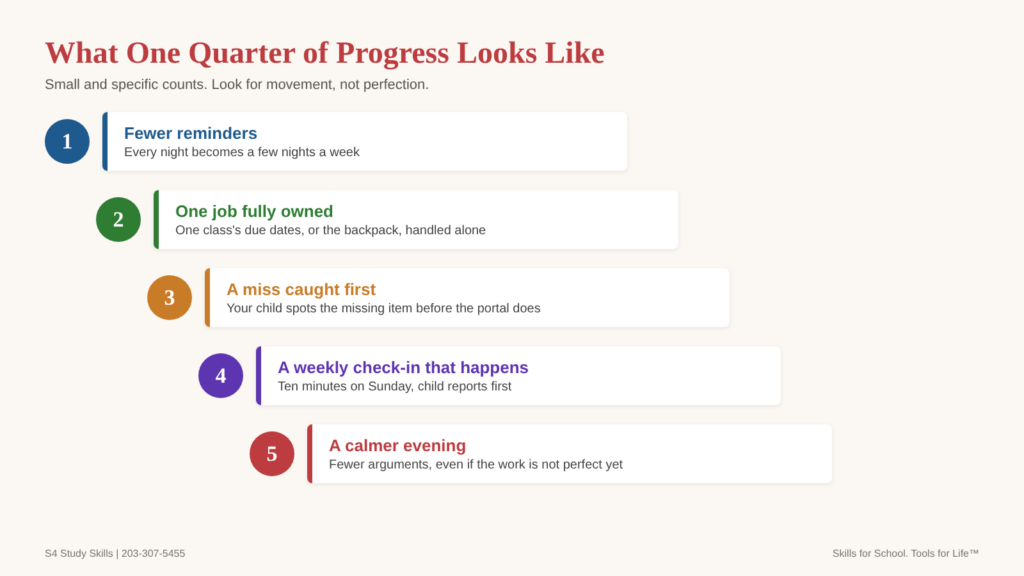
Progress usually looks small and specific. These are the changes worth noticing:
- Fewer reminders. Every night becomes a few nights a week.
- One job fully owned. Your child tracks one class’s due dates, or packs their own bag, with no help from you.
- A miss they caught first. A missing assignment your child noticed and raised before you saw it in the portal.
- A weekly check-in that happens. Ten minutes on Sunday, with your child reporting first.
- A calmer evening. Fewer arguments at homework time, even if the work is not perfect yet.
Our Homework Police Retirement Guide puts the handoff at about four weeks, with six to eight weeks before a new routine feels normal. If you see two or three of the changes above, keep going.
What if nothing changed?
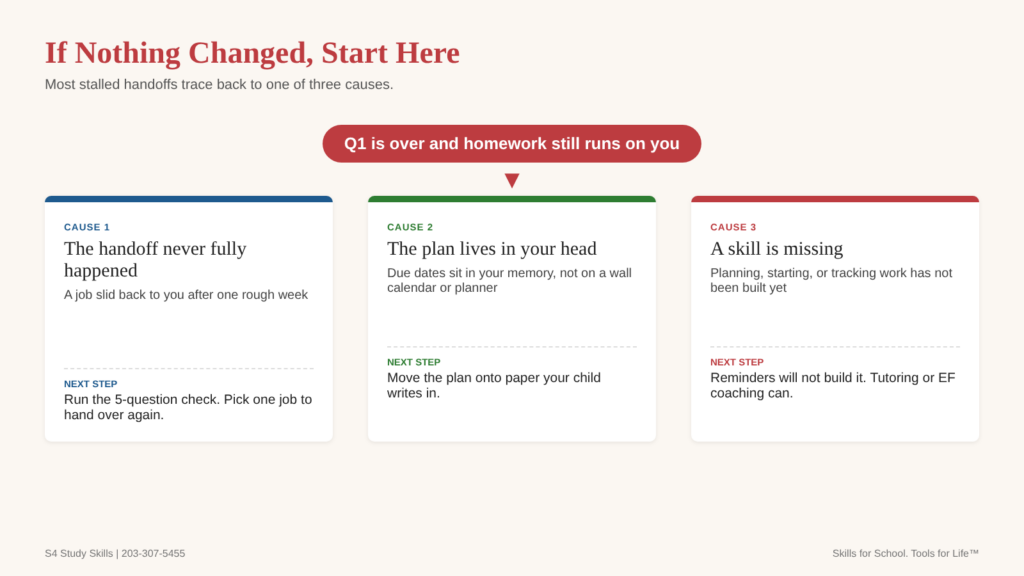
Then you have learned something useful, and it usually points to one of three causes.
- The handoff never fully happened. Many parents take a job back after one rough week. The self-check below shows which ones came back.
- The plan lives in your head. If due dates sit in your memory and not on a wall calendar or in a planner your child writes in, you are still holding the system.
- A skill is missing. Planning, starting, and tracking work are skills, and some students have not built them yet. More reminders do not build them.
A short dip in grades while a student takes over a job is common. A dip that lasts well beyond the first few weeks, even with a system in place, points to a skill gap. Our post on how often to check the parent portal covers how to stay informed without taking the job back.
How do you check what you are still carrying?
Count how many homework jobs you did for your child in the last seven days. Here is a five-question version:
- Did you remind your child to start homework?
- Did you write down, look up, or keep track of a due date for them?
- Did you check the parent portal more than once?
- Did you email a teacher about something your child could have raised?
- Did you fix, finish, or pack something your child could have done?
Three or more yes answers means some jobs have slipped back to you. Notice which ones, then pick one to hand over again.
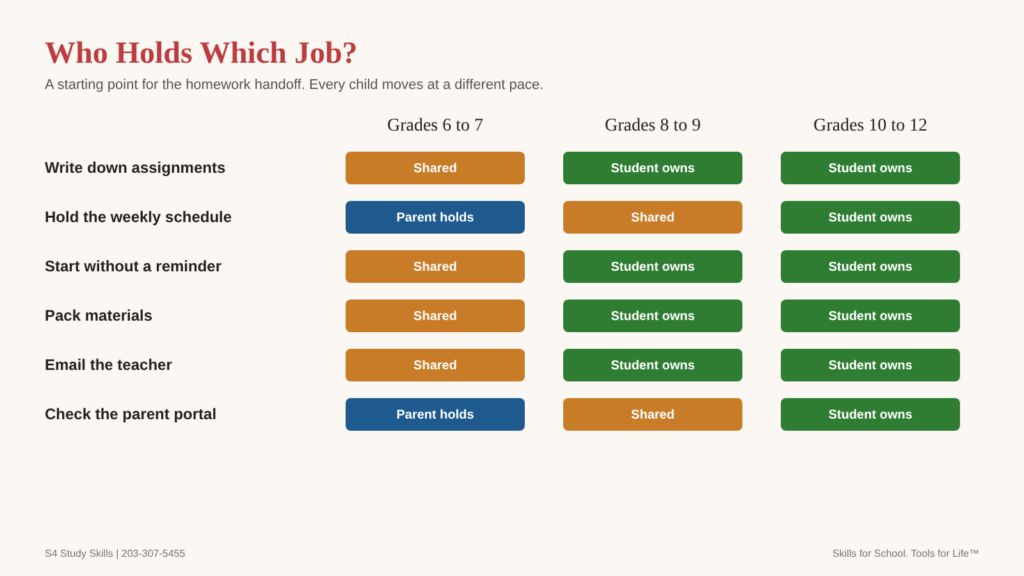
The free download has ten questions and a grade-by-grade grid of who should hold each job, from sixth grade through senior year.

Which signs point to an executive function gap?
Executive function is the set of mental skills students use to plan, start, and finish work. When those skills are still developing, effort alone does not produce results. Signs to watch for:
- Starting is the hardest part, even for work they understand.
- A planner exists, and assignments still go missing.
- They can explain the material out loud, and the grade does not show it.
- The same problem appears in several classes.
- The effort is real, and the results are thin.
- Homework conversations often end in a fight.
One of these in a hard week is normal. Several of them across a full quarter is a pattern worth a professional look. Our post on the 5 signs your student needs executive function coaching goes deeper. Students with ADHD often show several of these at once, and our ADHD tutoring page explains how we support them.
What is the difference between tutoring and executive function coaching?
Tutoring teaches the subject, and executive function coaching builds the system behind the work. Some students need one, and some need both.
| Academic tutoring | Executive function coaching | |
|---|---|---|
| What it targets | Content gaps in a subject | Planning, starting, and tracking work |
| What the work looks like | Practice and review in the subject itself | Building routines and tools around the student’s real assignments |
| Signs it fits | One subject keeps sliding. The same topic keeps coming back wrong. | Work goes missing despite a planner. Results are uneven across classes. |
| Where to start | Academic tutoring or math tutoring | Executive function coaching |
What happens in an S4 consultation?
You talk through what you are seeing, and S4 recommends the kind of help that fits. Bring your completed self-check and a screenshot of the portal or report card. Expect questions about what you have tried so far and what your child says about school. Then S4 suggests tutoring, coaching, both, or a plan to try at home first.

What should the second quarter look like?
Pick one new job to hand over, set a check-in date, and keep the Sunday meeting.
- Choose one job from your self-check, such as tracking due dates for one class.
- Tell your child the plan out loud, so the handoff does not feel like a surprise.
- Put a check-in on the calendar for about four weeks from now.
Connecticut and New York families: Marking period dates and report card timing are set by each district. First-quarter report cards often arrive in November in Fairfield County and Westchester County, so check your district calendar for the exact date. S4 works with families in Greenwich, Westport, Weston, New Canaan, Darien, Fairfield, Southport, Armonk, Bedford, Pleasantville and across Westchester County, in person and online.
Frequently asked questions
How do I know if my child needs help or just needs more time?
Look at how long the problem has lasted and whether a system was in place. A rough few weeks during a handoff is common. A problem that continues for a full quarter, with a planner or schedule in use, usually points to a missing skill and is worth a conversation with a professional.
What if the grades are fine but I am still doing most of the nagging?
Grades can hide how much work it takes to earn them. If the grades depend on your reminders, your checking, and your late-night rescues, the system still belongs to you. Pick one job to hand back and watch what happens in that one class.
Is it too late to change course in the middle of the school year?
No. The second quarter is a good time to start, because you now have a full quarter of information and the semester is still ahead. Choose one job to hand over, set a check-in date, and keep the plan small.
Will executive function coaching work for a teen who does not want help?
Many teens engage more when the work uses their real assignments and they choose the first goal. Resistance is common, and it does not rule out coaching. Ask about this during a consultation.
How is executive function coaching different from school support like an IEP or 504 plan?
An IEP or 504 plan sets out accommodations and services the school provides. Coaching builds the planning and organizing skills a student uses everywhere. The two can work side by side. If your child has a plan, ask the school team what is in place before adding outside support.
How often should we check in about homework after the first quarter?
Once a week works for most families. Hold a ten-minute Sunday meeting with your child reporting first: what is due, what will be hard, and what they need from you.
Does this apply to middle school students?
Yes, with different expectations. Sixth and seventh graders still need a parent to hold the schedule and the workspace, while they own writing down assignments and starting without a reminder. The retirement guide has the full grade table.

