

Your student spent three hours studying last night. You watched them. Notes spread across the table, highlighter in hand, music playing softly in the background. They looked busy. They looked focused.
Then they bombed the test.
“But I studied!” they insist. And you believe them. Because you saw it happen.
Here’s what most parents don’t realize: students don’t fail because they don’t study. They fail because they practice the wrong mental skill.
What are the most effective study strategies for high schoolers?
The most effective study strategies prioritize retrieval practice (active recall) over passive review. Research shows that techniques like the Leitner System and Cornell Note-taking consolidate memory significantly better than rereading or highlighting. These “active” methods force the brain to retrieve information, strengthening neural pathways for higher exam scores.
By mid-February, the initial semester energy has worn off. Students are settling into patterns, and those patterns determine whether grades improve or plateau for the rest of the year. If your middle schooler or high schooler is working hard without seeing results, the problem is likely methodology, not effort.
Why Highlighting Fails (And Why They Keep Doing It Anyway)
Walk into any high school library during exam week and you’ll see the same scene: students with colorful highlighters, marking up textbooks and notes in neon yellow, pink, and green.
It feels productive. It looks like studying. But highlighting creates what researchers call an “illusion of competence.”
When students highlight, their brains recognize the text. Recognition feels like understanding. The problem? Tests don’t measure recognition. They measure retrieval.
Highlighting trains recognition. Tests require retrieval.
That’s the fundamental disconnect. Your student can look at highlighted notes and think, “Yes, I know this.” Their brain is identifying familiar information. But when the test asks them to produce that information from memory without any prompts, the neural pathway doesn’t exist. They never practiced the actual skill the test measures.
Here’s why students keep defaulting to highlighting anyway: it’s fast, familiar, and requires no decision-making. There’s no cognitive discomfort. Passive reviewing feels easier because it is easier. The brain isn’t working hard enough to build lasting memory.
Real learning requires effort. When studying feels difficult, that struggle is actually the mechanism of memory formation. Students avoid that discomfort by choosing methods that feel smooth and easy.
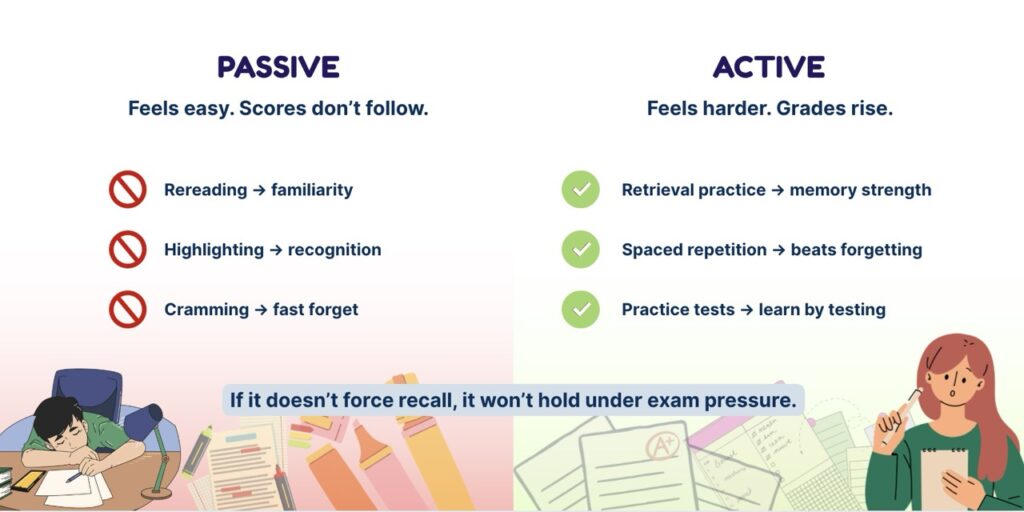
The Science: Passive vs. Active Study Methods
Understanding the difference between passive and active learning changes everything. Here’s what the research shows:
| Study Method | Learning Type | Effectiveness for Long-Term Retention | Why It Works (or Doesn’t) |
| Rereading Notes | Passive Learning | Low | Rereading builds familiarity, not memory. Students recognize information while reading but cannot retrieve it once the notes are closed. |
| Highlighting Text | Passive Learning | Low | Highlighting creates an illusion of understanding. The brain identifies key phrases but does not practice recalling information independently. |
| Cramming | Massed Practice | Very Low | Cramming overloads working memory and leads to rapid forgetting within days of the test. |
| Retrieval Practice | Active Learning | High | Retrieval practice strengthens memory by forcing the brain to recall information without prompts, improving test performance and retention. |
| Spaced Repetition | Active Learning | Very High | Spacing review sessions resets the forgetting curve, allowing information to move into long-term memory. |
| Practice Testing | Active Learning | High | Testing is a form of learning. Each attempt to recall information reinforces neural pathways needed during exams. |
Research consistently shows that active study strategies like retrieval practice, spaced repetition, and practice testing are far more effective than passive methods such as rereading or highlighting. Active strategies require students to recall information from memory, which strengthens long-term retention and leads to higher exam performance.
The pattern is clear. Active methods consistently outperform passive ones. But most students never learn this distinction. They study the way they were taught, which often means reading and reviewing until the material feels familiar.
That approach works well enough in elementary school when tests measure basic recall. By high school, when exams require application, synthesis, and complex retrieval, passive methods fail dramatically.

Strategy 1: The Leitner System (Spaced Repetition That Builds Decisions)
The Leitner System is a flashcard method that sounds deceptively simple but fundamentally changes how students approach memorization.
How it works:
- Create flashcards for material you need to learn
- Organize cards into boxes or digital categories based on mastery level
- Box 1: New or difficult material (review daily)
- Box 2: Content you’re starting to remember (review every 3 days)
- Box 3: Well-mastered information (review weekly)
During each study session, students quiz themselves. Cards they get right move forward to the next box. Cards they miss move back to Box 1.
Why this is more than just flashcards:
The genius of this system? It’s a decision-making framework, not just a memorization tool.
Students constantly evaluate their own understanding. They’re forced to be honest about what they actually know versus what feels vaguely familiar. The system externalizes metacognition, making it visible and actionable.
The results:
Students who implement this system and stick with it outperform those who reread by over 50% on delayed tests.
Why does it work so well? Because it mimics exactly what happens during an exam. The flashcard asks a question. The student must retrieve the answer from memory without any external prompts. That retrieval process strengthens the neural pathway every single time.
Practical implementation:
Physical flashcards work fine, but digital tools automate the spacing:
- Anki (highly customizable, free)
- Quizlet (user-friendly, social features)
- Both track which cards need review and when
The Leitner System also reduces cognitive overwhelm. Instead of staring at 200 vocabulary words wondering where to start, students have a clear system telling them exactly what needs attention today.
Strategy 2: Cornell Notes 2.0 (The Built-In Self-Testing System)
Most students take notes wrong. They write down everything the teacher says in one long stream of information. Then they reread those notes before tests, hoping something sticks.
Cornell Notes fixes this by building retrieval practice directly into the note-taking structure.
The three-section setup:
- Right side (2/3 of page): Regular notes during class
- Left side (1/3 of page): Stays blank during lecture
- Bottom section: Reserved for summary
Here’s the part most students miss: the left column isn’t for notes. It’s for questions.
How to use Cornell Notes effectively:
During class:
- Take notes normally on the right side
- Leave the left column completely blank
- Focus on capturing key concepts, not transcribing everything
After class (within 24 hours):
- Review your right-side notes
- Generate questions in the left column
- For every concept, fact, or formula on the right, write a question on the left that would prompt that information
When studying:
- Cover the right side with a blank paper
- Look only at the left column questions
- Test yourself by trying to answer each question from memory
- Uncover the right side to check your accuracy
- Mark questions you missed for additional review
The summary section: After covering the material, write 2-3 sentences synthesizing the main ideas. This forces processing and consolidation rather than just transcription.
Why it works:
This transforms notes from passive reference material into an active study tool. Students aren’t just reading their notes hoping to remember. They’re actively practicing the exact skill tests measure: producing information when prompted by a question.
Cornell Notes work because they externalize good study habits. Students don’t need to remember to quiz themselves separately. The structure itself demands active engagement.
Strategy 3: Mind Mapping for ADHD (Externalizing Connections to Reduce Cognitive Load)
Linear notes don’t work for every brain. Students with ADHD particularly struggle with traditional note-taking because it requires sustained sequential processing and working memory.
Mind mapping offers a completely different approach by externalizing thought and making relationships visible.
The basic structure:
- Central concept goes in the middle of the page
- Main ideas branch out from the center
- Supporting details branch from those main ideas
- The result: a visual web showing how concepts connect
Why this helps ADHD students specifically:
Reduces working memory load: Everything appears on the page at once. Students don’t have to hold multiple ideas in their head simultaneously while trying to understand how they relate.
Engages multiple learning channels: Students are drawing, connecting, color-coding. This physical engagement helps maintain focus and attention in ways that linear writing doesn’t.
Provides a clear entry point: For students who struggle with “where to start” paralysis, mind mapping offers an obvious beginning. Put the main topic in the center. Add one branch. Then another. The structure builds organically rather than requiring a pre-planned outline.
Best uses for mind mapping:
Works well for:
- History (cause and effect relationships)
- Literature (character connections, themes)
- Science concepts (systems and processes)
- Social studies (interconnected ideas)
Less effective for:
- Math formulas (better with Leitner System)
- Vocabulary lists (better with flashcards)
- Pure memorization tasks
Tools and methods:
- By hand: Most flexible, highly kinesthetic
- Coggle: Simple, collaborative, free version available
- MindMeister: More features, good for complex topics
The key to effective mind mapping:
Every connecting line should represent a specific relationship, not just vague association. Label your connections. “Causes,” “leads to,” “contrasts with,” “supports.” This makes the thinking explicit and reinforces understanding.
For students who struggle with linear organization, mind mapping externalizes the cognitive work of seeing how ideas fit together. The visual layout does what their working memory struggles to maintain internally.

The Real Challenge: Knowing vs. Doing
Here’s what the research won’t tell you but every parent needs to hear: knowing these strategies is the easy part. Using them consistently under pressure is where students actually struggle.
Your student can understand that retrieval practice beats rereading. They can learn how to create Cornell Notes or use the Leitner System. But when they’re overwhelmed with three tests and two papers due the same week, they’ll default back to highlighting and cramming because it feels faster.
That’s not a motivation problem. That’s an executive function gap.
Changing study habits requires:
- Task initiation to start the new method when the old way is more comfortable
- Planning to build these techniques into a realistic study schedule
- Self-monitoring to notice when they’re slipping back into passive habits
- Frustration tolerance to persist through the awkward learning curve
This is where coaching becomes essential. Students need someone to help them implement these strategies consistently, not just understand them theoretically. They need accountability when they want to give up. They need help troubleshooting when the method doesn’t work the first time.
At S4 Study Skills, we explain the use of evidence-based techniques while teaching students how to actually use them until they become automatic. Because understanding or studying science without implementation support is like knowing how to exercise but never going to the gym.
Frequently Asked Questions
How often should my student review their notes?
Follow the 1-2-7-14 rule. Review material on Day 1 (the day you learn it), Day 2, one week later, and two weeks later. This spacing pattern resets the forgetting curve and moves information into long-term memory. Each review should be active (testing yourself) rather than passive (rereading).
Can AI help with these study strategies?
Yes, but with boundaries. Tools like NotebookLM can turn notes into audio summaries, which works well for auditory learners who want to review while commuting or exercising. ChatGPT can generate practice questions based on study material. The key is using AI to support retrieval practice, not replace the thinking work. Students should generate their own questions first, then use AI to supplement.
Is it better to study in one place or multiple places?
Changing your environment can actually improve retention. The brain encodes contextual details along with information. Studying in varied locations creates multiple retrieval cues. During high-stress exam weeks, this environmental variety can boost both focus and recall. Just make sure each location supports concentration.
My student says these methods take too much time. What do I tell them?
These strategies feel slower initially because they require more mental effort than passive reviewing. But they’re dramatically more efficient over time. Three 20-minute retrieval practice sessions spaced over several days will produce better results than five hours of cramming. The question isn’t time invested. The question is which methods actually create lasting memory.
What if my student has learning differences that make traditional studying even harder?
Students with ADHD, dyslexia, or other learning differences often benefit most from these active methods because passive reviewing fails them more dramatically. The key is customization. A student with ADHD might combine mind mapping with the Leitner System. A student with dyslexia might use Cornell Notes with audio recording. Executive function coaching helps identify which combination works for each individual learner.
Moving From Theory to Practice
By now you understand why highlighting doesn’t work and what strategies the research supports. You might even feel excited to share these techniques with your student.
Here’s what will probably happen: your student will try one of these methods once, decide it’s too hard or takes too long, and revert back to their comfortable (ineffective) habits.
That’s completely normal. Behavior change is hard, especially when the old behavior feels easier in the short term.
The students who successfully transition to evidence-based study strategies almost always have external support during that transition. A coach who helps them implement the Leitner System for the first time. A tutor who teaches them how to generate Cornell Note questions. A structured workshop where they practice these techniques with guidance.
At S4 Study Skills, our Essential Study Skills workshops exist for exactly this purpose. We don’t just teach the theory, we work with students to implement these methods until they become habitual, troubleshoot when something doesn’t work, and provide accountability when motivation wanes.
Because the difference between students who know about effective study strategies and students who actually use them is consistent external support during the learning curve.
If your student is working hard without results, the problem is probably methodology. And methodology is completely fixable with the right guidance.
Ready to help your student study effectively instead of just hard? Contact us at 203-307-5455 or info@s4studyskills.com to learn about our study skills coaching programs.
The highlighter isn’t the answer. Active retrieval is. We’ll help your student make that shift.

