

Note: While this is for AP exams, our study tips and practical strategies are still applicable for final exams.
AP exams start May 4. If your student is registered for two, three, or four exams over the next two weeks of testing, the preparation window is measured in days now, not months. The students who perform well across multiple APs share a common trait: they study strategically rather than trying to cover everything at once.
At S4 Study Skills, we work with students in Greenwich, Darien, Westport, Scarsdale, and beyond who face this exact challenge every spring.
The approach that works consistently comes down to executive function skills, planning, prioritization, and pacing, rather than logging more hours with a textbook.
How Should a Student Study for Multiple AP Exams at the Same Time?
Students studying for multiple AP exams need a rotation system, not a marathon. The most effective approach assigns each subject to specific days and limits active study to one AP per evening session.
Trying to review three subjects in a single sitting leads to interference, where the material from one exam blurs into another.
A practical weekly rotation looks like this:
- Assign your two weakest subjects three study sessions per week each
- Assign your strongest subject two sessions per week
- Each session runs 45–60 minutes of focused review, followed by a 10-minute break
- After two sessions in one evening, stop. Consistency across weeks beats weekend cramming every time.
The students we coach build what we call a diagnostic-first study plan. Before reviewing any content, they take a practice section in each subject to identify actual gaps.
This prevents the most common AP prep mistake: spending time on material they already know while neglecting the units they forgot from September.
What Does an AP Exam Study Schedule Look Like with 4 Weeks Left?
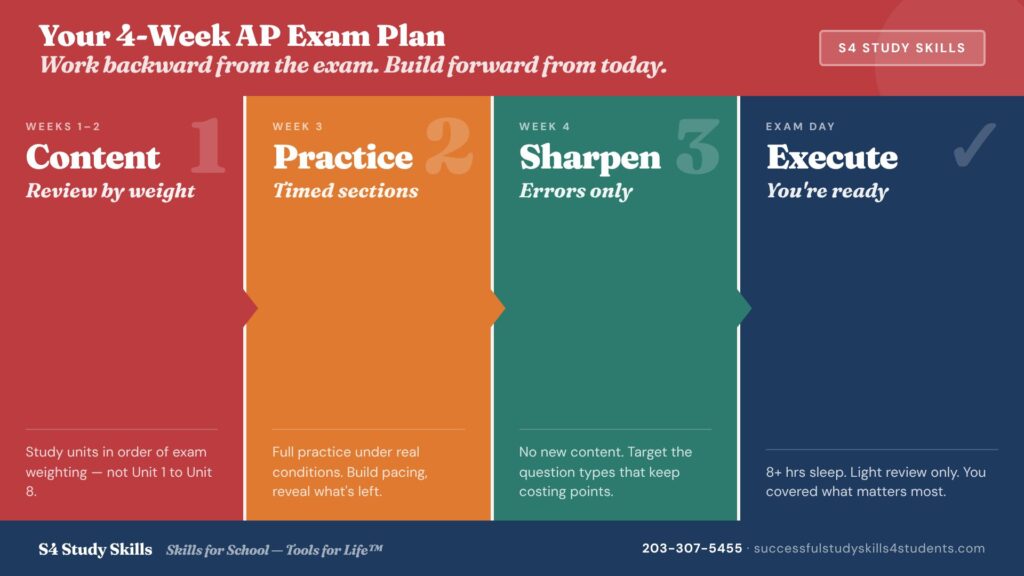
With four weeks until exams, an effective schedule is divided into three phases:
Weeks 1–2: Content review by unit.
Prioritize the units weighted most heavily on each exam, not Unit 1 through Unit 8 in order. The College Board publishes unit weighting in the Course and Exam Description for every subject.
Week 3: Timed practice sections.
Shift from content review to full practice sections under realistic conditions. This builds pacing skills and reveals which gaps remain.
Week 4 (final week before each exam):
Targeted error review only. No new content. Review the question types and topics that consistently cost points in practice. Narrow the focus, sharpen the execution.
Students taking AP US History, for example, can see that certain periods carry 10–17% of the exam weight. A student who reviews units in order of weighting covers the highest-value material first, and avoids running out of time on low-weight units they already know.
For students juggling three or four exams, sequencing matters.
If AP Chemistry falls on May 5 and AP English Literature falls on May 6, those two subjects need front-loaded prep in weeks one and two. Exams in the second testing week (May 11–15) can receive more attention in weeks two and three.
Why Do Some Students Burn Out During AP Season While Others Stay Steady?
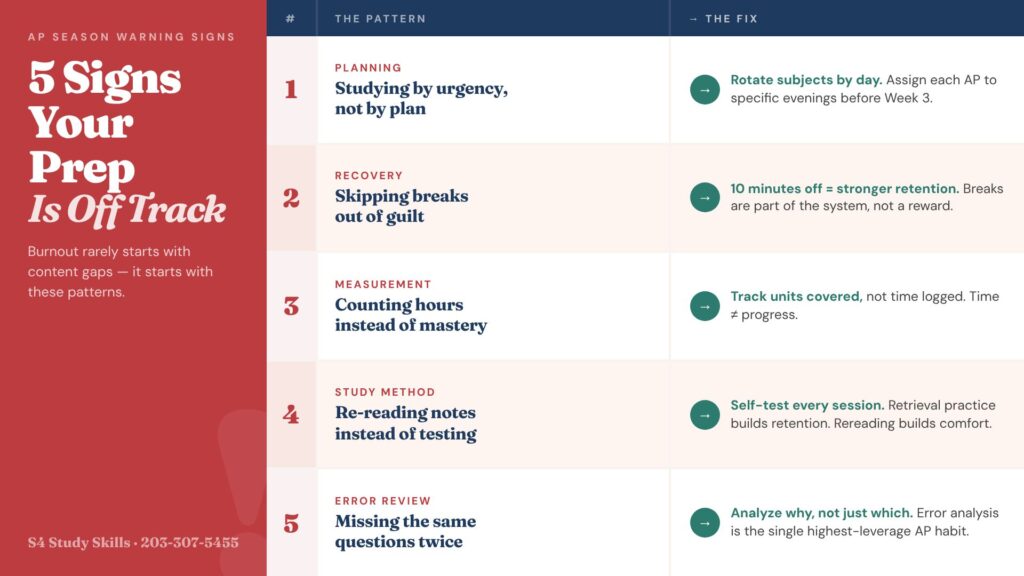
Burnout during AP season almost always traces back to an executive function gap rather than a content gap. Students who burn out share a predictable set of patterns:
- They study reactively (whatever feels most urgent) instead of by plan
- They skip breaks because they feel guilty resting
- They measure preparation by hours spent rather than material mastered
- They review passively (rereading notes) instead of actively (self-testing)
Research consistently shows that spaced practice (shorter sessions distributed across days) produces stronger retention than massed practice.
A student who studies AP Biology for 45 minutes on Monday, Wednesday, and Friday retains more than a student who crams for three hours on Sunday night.
The emotional dimension matters too.
Students in high-achieving communities like those in Fairfield and Westchester counties often compare their AP loads against peers. A student taking three APs might feel inadequate next to a classmate taking five.
We help students focus on their own performance targets rather than external benchmarks, because the goal is scoring well on the exams they chose, not matching someone else’s schedule.
How Can Parents Support AP Prep Without Taking Over?
The most effective parent role during AP season is structural support, not content tutoring. That means helping your student build the study calendar, protecting evening study blocks from scheduling conflicts, and monitoring energy levels for signs of burnout, without quizzing them on historical dates or chemical equations.
Practical ways to support without hovering:
- Build the master calendar together. One view that shows all AP exam dates, school deadlines, and extracurricular commitments. Most students don’t see the full picture until it’s mapped out.
- Ask which subjects feel strongest and weakest, then step back. Let them allocate time based on their own assessment. Ownership drives follow-through.
- Protect sleep above all else. The research on sleep deprivation and test performance is unambiguous: even one night of poor sleep before an exam reduces cognitive performance measurably.
- Stock the house with protein-forward snacks and limit caffeine after 2pm during the final prep weeks.
- Watch for avoidance patterns. If your student is dodging a particular subject, that’s diagnostic. It usually signals the area where they feel least prepared, which means it needs more attention, not less.
A gentle observation (“I notice you haven’t touched your APUSH review this week, what’s going on with that one?”) opens a conversation without creating pressure. That’s the shift from Homework Police to Strategic Consultant that we teach at S4.
What’s the Difference Between Strategic AP Prep and Cramming?
The distinction drives score differences of 1–2 points on the AP scale. Here’s how the approaches compare:
| Category | Strategic Approach | Cramming Approach |
| Timeline | 4+ weeks of distributed practice | Final week or weekend before the exam |
| Daily hours | 45–90 min per subject | 3–5 hours in a single session |
| Content coverage | Weighted by exam unit importance | Start at Unit 1, run out of time |
| Practice tests | 2+ full-time tests per subject | Skim answer keys without timing |
| Error analysis | Categorize mistakes by type | Check answers, move on |
| Sleep before the exam | 8+ hours, protected routine | Late night, caffeine-dependent |
| Burnout risk | Low—sustainable daily rhythm | High—crash after first exam |
The students who improve between practice tests and exam day are the ones analyzing why they missed questions—not just which ones they missed. Error analysis is the single highest-leverage study activity for AP exams, and it requires executive function skills that many students haven’t been explicitly taught.
Frequently Asked Questions: Studying for Multiple AP Exams
How many AP exams is too many?
There is no universal number. The right AP load depends on the student’s executive function capacity, extracurricular commitments, and whether they have support systems in place. We typically see students manage 3–4 exams well with strategic planning. Beyond that, performance on individual exams often drops unless the student has strong organizational skills.
Should my student study for AP exams over spring break?
Spring break is an ideal time for a structured diagnostic: take one practice section per subject, identify weak units, and build the study plan for the remaining weeks. We recommend no more than 2–3 hours of focused review per day during break to avoid fatigue before the final push.
Is one month enough to prepare for AP exams?
For students who have been engaged in their AP courses all year, one month is sufficient for strategic review and practice. For students who have significant content gaps, one month requires more intensive daily sessions and realistic expectations about score targets.
What if my student has two AP exams on the same day?
The College Board offers late testing (May 18–22, 2026) for students with scheduling conflicts. Contact your school’s AP Coordinator immediately to arrange an alternate exam version.
Do colleges care more about AP exam scores or course grades?
Most admissions officers weigh the course grade more heavily than the exam score. However, strong AP scores confirm that the grade reflects genuine mastery. For students at competitive Fairfield and Westchester County schools, AP scores of 4 or 5 reinforce a strong transcript.
How does executive function coaching help with AP preparation?
Executive function coaching addresses the planning, time management, and self-monitoring skills that determine how effectively a student uses their study time. We teach students to build study calendars, conduct error analysis, manage cognitive fatigue, and prioritize across competing demands—skills that transfer to every exam, not just APs.

S4 Study Skills serves families in Fairfield County (Greenwich, Darien, Westport, New Canaan, Fairfield) and Westchester County (Scarsdale, Chappaqua, Armonk) with executive function coaching, study skills tutoring, and SAT/ACT preparation. Call 203-307-5455 to schedule a consultation.

