

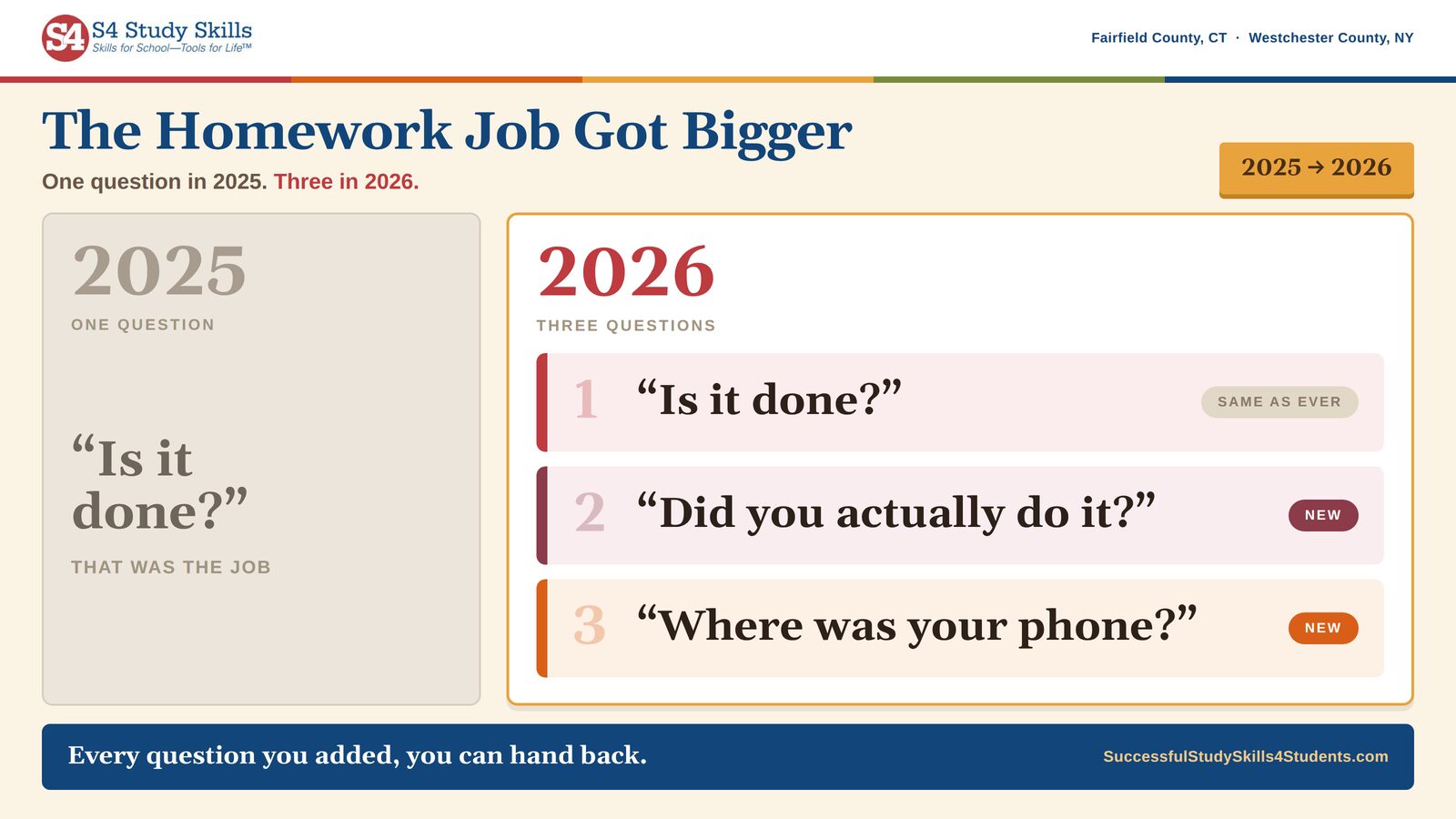
Being the homework police means running your child’s assignments for them. You remind, you check, you negotiate, and you rescue at 11 PM. In 2026 that job got bigger. Parents used to monitor one thing, whether the work got done. Now many are monitoring three: whether it got done, whether their child actually did it, and what the phone was doing the whole time. This guide covers what changed, what the research says about nightly monitoring, and how to hand ownership back to your student without watching the grades collapse.
What does it mean to be the homework police?
Homework policing is any system where the parent carries the responsibility that belongs to the student. The student does the work. The parent holds the plan, the deadlines, and the worry.
It usually looks like this:
- Asking “is your homework done?” more than twice in one evening
- Checking the parent portal on a schedule instead of on a reason
- Knowing your child’s assignment due dates better than they do
- Sitting next to them so the work happens
- Editing, retyping, or finishing sections yourself when it gets late
- Emailing the teacher about a missing assignment before your child has
None of that makes you a bad parent. It makes you a responsible one who inherited a job nobody assigned you. The problem is what it teaches. A student whose parent holds the system never builds one.
Why did the homework policing job get bigger in 2026?
Two changes landed at once: AI writing tools became normal in middle and high school, and state device rules changed what happens to phones during the school day.
AI changed the authorship question. Before 2023, a finished essay on the kitchen table answered the question. Now parents look at the same essay and wonder who wrote it. That is a new category of worry, and there is no clean way to resolve it from the outside.
Device policy changed the focus question. New York adopted statewide bell-to-bell restrictions on internet-enabled personal devices, in effect for public schools, charters, and BOCES starting in the 2025-26 school year. Connecticut took a different route. On August 5, 2026, the Connecticut State Board of Education adopted guidance that strongly recommends bell-to-bell restrictions and asks districts to audit how much of the school day runs on screens. Connecticut’s version is guidance rather than a mandate, so districts decide.
The result for parents: a student who was separated from their phone for seven hours arrives home with all of that attention available at once. The homework hour absorbs it.
Fairfield County and Westchester County: same commute, different rules
Families thirty minutes apart are now working from different rulebooks.
- Westchester County, NY: a statewide requirement. Your district has a bell-to-bell policy because the state law requires one. Storage and enforcement are decided locally.
- Fairfield County, CT: state guidance, adopted August 2026. Your district may have a strict policy, a loose one, or one that changes this fall as boards respond to the new recommendation.
Practical takeaway: read your own district’s current policy before you set a home phone rule. A rule that contradicts the school day confuses the student and undercuts you.
Which homework parent are you this year?
Last year we named seven homework personalities. This year there are nine. Both new ones come from the same place. The job got bigger, so it grew two new ways to do it.
The Detective reads the edit history before reading the essay, and runs paragraphs through AI detectors. Try this instead: ask your child to explain their thesis out loud. A student who wrote it can do that in thirty seconds. A student who did not will struggle by the second question.
The Portal Refresher checks grades four times a day and knows the score before the teacher has finished entering it. Try this instead: turn off push notifications and pick one day a week to look. Once a week is enough for most families.
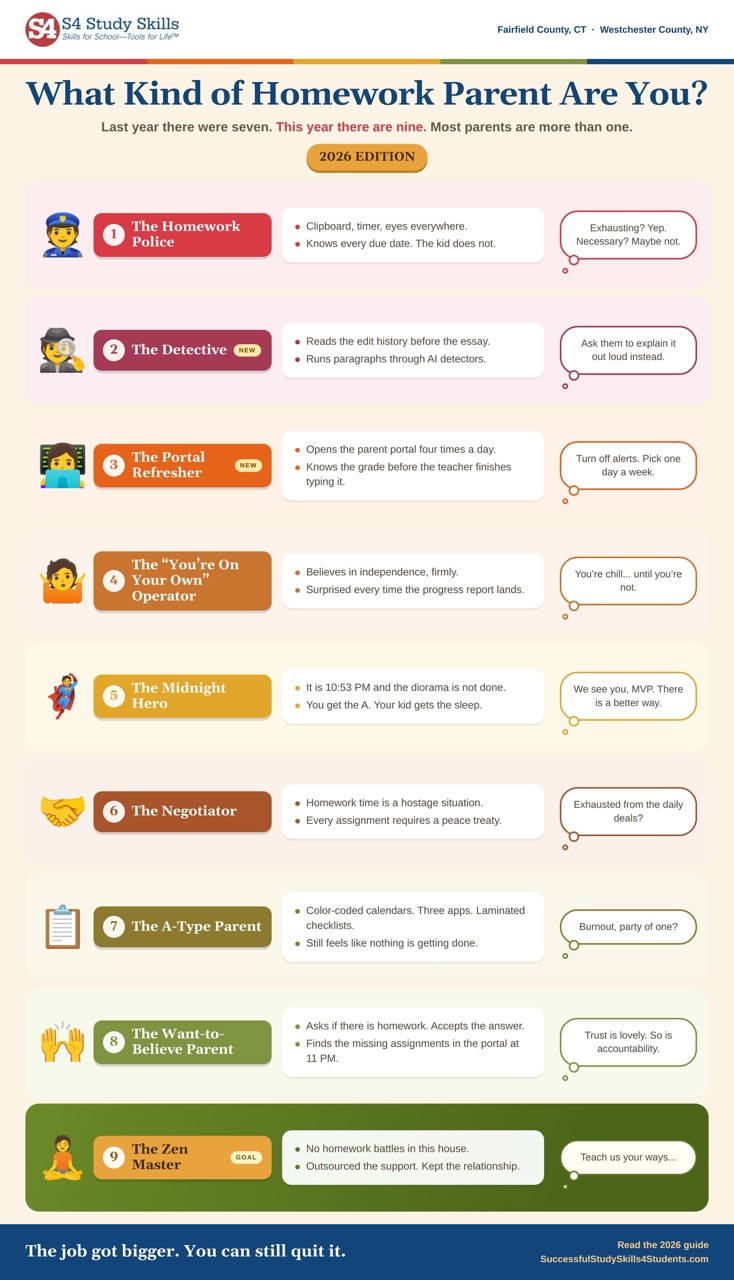
The original seven are all still here. Find yours in last year’s list. Most parents are more than one, and almost nobody starts out as the Zen Master.
What are parents actually monitoring now?
The job grew from one question to three. Here is the shift.
| What you monitor | 2025 | 2026 |
| Completion | “Is it done?” Backpack check, portal check | Same, plus real-time portal alerts on every entered grade |
| Authorship | Rarely questioned | Version history, AI detectors, asking your child to explain their own thesis |
| Focus | “Put your phone away” | Depends on your district’s policy, which may have changed this year |
| Evidence you can see | Grades and teacher emails | Grades, teacher emails, timestamps, revision history, submission logs |
| Time cost per night | One conversation | Three conversations, or one long one |
Every row added is a row you can hand back. That is the point of the rest of this guide.
Does checking homework every night improve grades?
On its own, no. The research on parent involvement in homework is more complicated than “help more, do better,” and the type of involvement matters more than the amount.
The clearest synthesis on this is Patall, Cooper, and Robinson (2008) in Review of Educational Research. Across 22 samples from 20 studies, they found:
- Positive associations for elementary and high school students
- A negative association for middle school students
- Parent rule-setting showed a stronger association with achievement than other involvement strategies
- A negative association for math achievement, a positive one for verbal outcomes
That third finding is the one worth reading twice. Setting structure outperformed direct help. Rules about when and where work happens did more than sitting beside your child correcting it.
Keith Robinson and Angel Harris reached a related conclusion in The Broken Compass (Harvard University Press, 2014), reporting that many common forms of parental involvement, including regular homework help, showed little measurable benefit and in some cases a negative association with achievement.
Two honest caveats. These are associations, not proof of cause. And a struggling student who receives no support does not automatically improve. The finding is narrower than the headline: structure helps, surveillance does not, and middle school is where over-involvement is most likely to backfire.
What should parents do instead?
Trade monitoring for structure. Four moves, in order of how much they change the household.
- Set the container, not the content.
Decide when homework happens, where it happens, and where the phone lives during it. Then stop. The rules are yours. The work is theirs.
- Move from questions to one check-in.
Replace nightly interrogation with one scheduled conversation a week. Sunday evening works for most families. Three questions: What is due this week? What is going to be hard? What do you need from me?
- Make the plan visible instead of verbal.
A wall calendar, a whiteboard, or a planner your student writes in themselves. When the plan lives on the wall, you can look at it instead of asking. This alone removes most of the reminders.
- Let the natural consequence arrive.
A missed assignment in September costs almost nothing. The same lesson in April of junior year costs a great deal. Early, low-stakes failure is the cheapest teacher your student will ever have.
Read more on when to step in and when to step back.
How do you hand over ownership without grades collapsing?
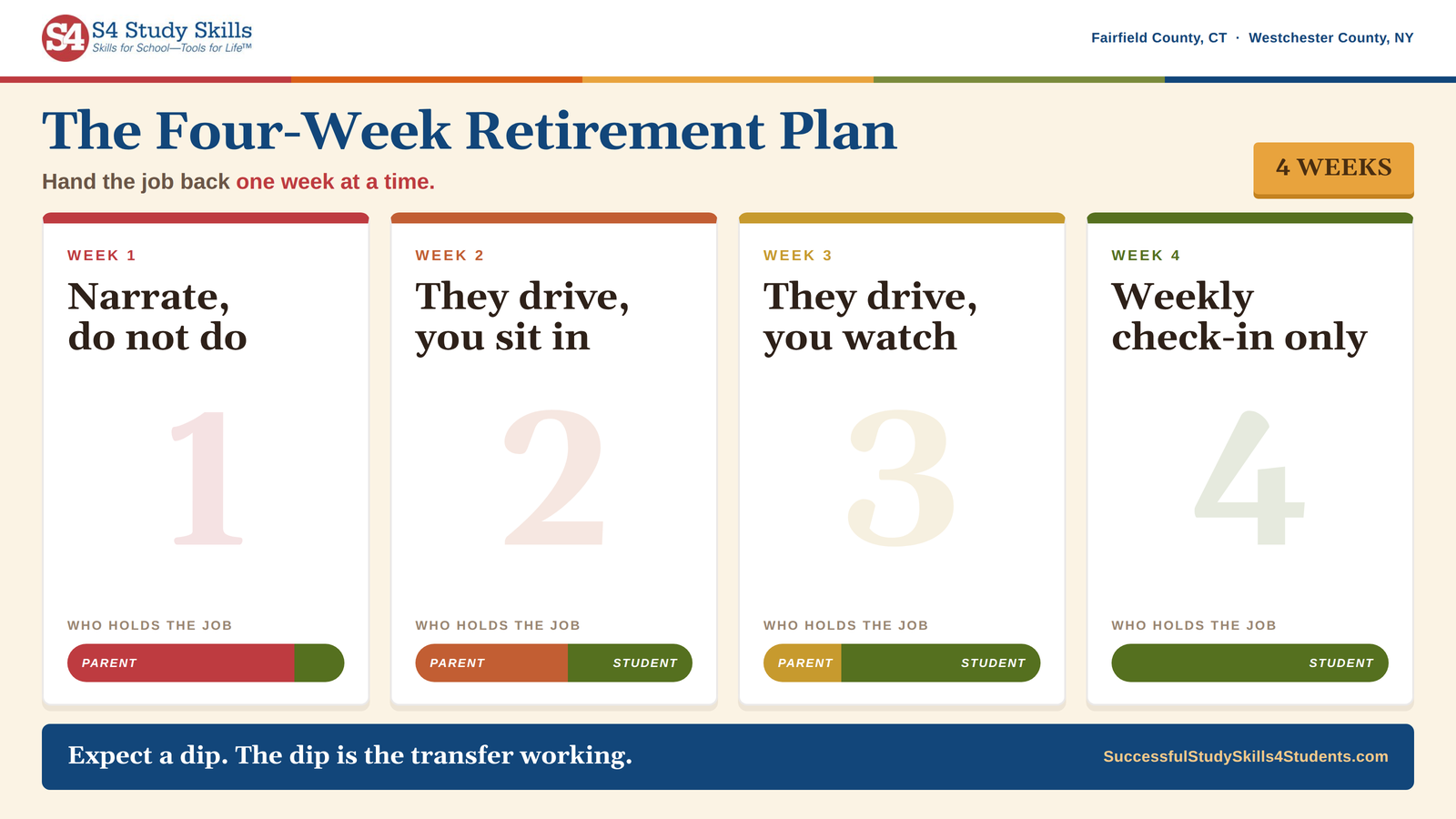
Do it in stages over about four weeks, and tell your student the plan out loud before you start. A handoff your child does not know about reads as abandonment.
Week 1: Narrate, do not do.
Keep your current level of help. Say what you are doing as you do it. “I am checking the portal now. Here is what I am looking for.” You are showing them the job.
Week 2: They drive, you sit in.
Your student checks the portal, writes the plan, and sets the schedule. You watch and stay quiet. Correct nothing that is not going to cause real damage.
Week 3: They drive, you check the mirror.
No daily involvement. One mid-week glance at the portal that you do not comment on unless something is genuinely off track.
Week 4: Weekly check-in only.
The Sunday conversation is now the entire system. You have retired.

What to do when something slips
Expect a dip. Grades often fall slightly in weeks two and three and recover by week five or six. That dip is the transfer working.
- One missed assignment: say nothing. Let them see it in the portal themselves.
- Two or three in a week: bring it to the Sunday check-in as a question, not a verdict. “I saw three missing. What happened?”
- A pattern past three weeks: the system is the problem, not the effort. That is a signal to change the plan or bring in help.
What does homework independence look like at each grade level?
Independence is a handoff, not a switch. This is a reasonable target range, not a diagnosis. Students with executive function challenges often run one stage behind, and that is normal.
| Grade | Student owns | Parent still owns | Check-in frequency |
| 6-7 | Writing assignments in a planner, starting work without a reminder | The schedule, the workspace, the phone rule, portal monitoring | Brief daily |
| 8-9 | Planning multi-day projects, tracking their own due dates | The weekly structure, help when asked, big-picture grade view | Two or three times a week |
| 10-11 | Full calendar ownership, breaking down long assignments, emailing teachers | Deadlines that affect the family, testing timeline, stepping in on crisis only | Weekly |
| 12 | Everything academic, including advocating for themselves with teachers | Nothing academic. College logistics only. | Monthly or on request |
If your junior still needs daily reminders to start homework, that gap is worth addressing now. College removes the reminder system entirely.
When is outside support the right call?
Handle it at home when the issue is a habit. Bring in support when the issue is a skill your student does not have and you cannot teach without damaging the relationship.
Consider outside help when you see:
- The handoff stalls past six weeks with no improvement in the pattern
- Effort is real and results are not. Your child is working and grades still slip.
- Every conversation about school ends in a fight. The relationship cost is now higher than the academic cost.
- Executive function is the gap, not the content. They understand the material and cannot start, plan, or finish.
- A diagnosis is in play and the school accommodations are not enough on their own.
- You have already tried subject tutoring and the same problems returned in the next unit.
That last one matters. Subject tutoring fixes a chapter. Executive function coaching fixes the system that keeps producing the problem. S4 has worked with middle school, high school, and college students in Fairfield and Westchester counties since 2010 on exactly this: organizing, note-taking, time management, test preparation, and the executive function strategies underneath all of it.
Frequently asked questions
At what age should I stop checking my child’s homework?
There is no single age. A reasonable target is daily involvement through 7th grade, weekly by 10th, and almost none by senior year. Match the handoff to demonstrated skill rather than birthday. A capable 8th grader can run their own system, and a struggling 11th grader may need to rebuild from an earlier stage.
What if my child’s grades drop after I stop checking?
A short dip is expected and usually appears in the second or third week. Most students recover within six weeks once they feel the consequence themselves. Treat a dip past six weeks as information, not failure. It means the student is missing a specific skill, most often planning or task initiation, and needs instruction rather than more monitoring.
How long does the transition usually take?
Plan on four weeks for the handoff and six to eight weeks before the new routine feels normal. Households that have been in daily-monitoring mode for years take longer, because the student has to learn the job and the parent has to learn to stop doing it.
Does this apply to students with ADHD?
Yes, with adjustments. Students with ADHD benefit from the same shift from monitoring to structure, and they typically need more external structure for longer and a slower handoff. Expect to run one stage behind the grade-level table above, keep the visible plan in place permanently, and check in twice a week rather than once. Independence is still the goal. The timeline is different.
Should I use the parent portal at all?
Use it, on a schedule you set in advance. Once a week is enough for most families. Real-time alerts on every entered grade turn a useful tool into an anxiety machine, and they pull you back into daily monitoring without a decision ever being made. Turn off push notifications and pick a day.
What should I do if I think my child used AI on an assignment?
Ask them to explain the work to you out loud. A student who wrote it can talk about it. A student who did not will struggle within two questions. Avoid relying on AI detection tools to settle it. Liang and colleagues, publishing in Patterns in 2023, found that widely used GPT detectors consistently misclassified writing by non-native English speakers as AI-generated and cautioned against using these tools in educational settings. If a real integrity issue exists, the conversation belongs with the teacher.
My child’s school changed its phone policy this year. Does that change anything at home?
It changes the starting point. Read your district’s current policy first, then set a home rule that matches its logic. Westchester families are working under a New York state requirement for bell-to-bell restrictions. Fairfield families are working under Connecticut guidance adopted in August 2026, which districts may adopt differently. A student who has been separated from their phone all day arrives home with a large amount of stored attention, and the homework hour is where it lands. Plan for that instead of being surprised by it.
The one-page version
Get The Retirement Plan, our one-page ownership transfer checklist. It lays out the four-week handoff, what to say in each stage, and the grade-level targets in a format you can put on the refrigerator.

