

Four weeks of school remain. And somewhere between spring break and now, your student stopped showing up, not physically, but mentally.
The backpack sits untouched until 9 pm. Assignments that used to take 30 minutes now take three hours of negotiation. When you ask about school, you get one-word answers or silence.
You’re watching the grades drift downward and wondering how a student who was doing reasonably well in January can look this disengaged in April.
If that description resonates, your household is in the majority right now. This is the point in the year when the gap between students with executive function systems and those who’ve been getting by on willpower becomes impossible to ignore.
At S4 Study Skills, we work with families across Greenwich, Darien, Westport, Scarsdale, and New Canaan who describe this same pattern every April.
The good news: four weeks is enough time to stabilize grades, finish strong on finals, and avoid the end-of-year collapse. But it requires a different approach than pushing harder.
Why Do Students Check Out at the End of the School Year?
The end-of-year shutdown is driven by a combination of cognitive fatigue, structural changes, and motivation depletion, not laziness. Understanding why it happens changes how you respond to it.
- Nine months of willpower is not sustainable. Students who lack strong executive function systems rely on raw effort and parental scaffolding to stay organized. That strategy can carry them through much of the school year, but by April, it catches up with them. Focus fades, motivation drops, and even routine academic tasks begin to feel overwhelming.
- The school structure loosens at exactly the wrong time. Many teachers shift to review mode, independent projects, and less frequent grading in the final weeks. For students who depend on external deadlines and teacher check-ins to stay on track, this reduction in structure is destabilizing.
- The finish line is visible but feels unreachable. Four weeks sounds short to an adult. To a teenager staring at a pile of missing assignments, three upcoming projects, and finals they haven’t started studying for, four weeks feels like an overwhelming amount of work they can’t organize their way through.
- The weather and social pull intensify. Longer days, warmer weather, plans with friends, and end-of-year events all pull attention away from academics at a time when students are already struggling to prioritize schoolwork.
How Can I Tell If My Student Is Struggling vs. Just Being a Teenager?
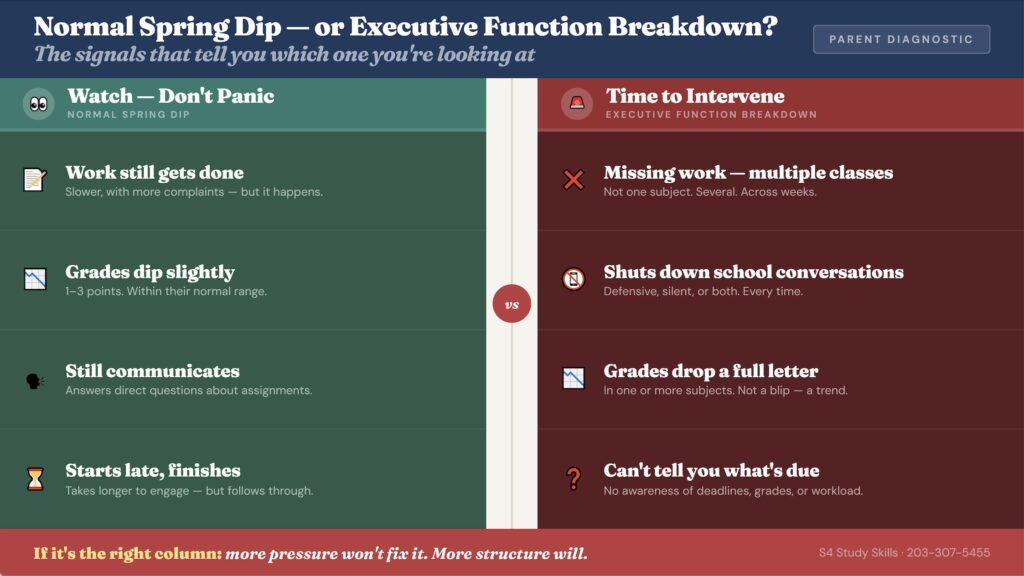
Every teenager’s motivation dips in the spring. But there’s a difference between a mild slowdown and a genuine executive function breakdown. Here’s how to tell:
Normal spring dip (watch but don’t panic):
- Complains about school more than usual, but still completes work
- Takes longer to get started, but eventually follows through
- Grades dip slightly (1–3 points) but stay within their typical range
- Still communicates about assignments when asked directly
Executive function breakdown (time to intervene):
- Multiple missing or incomplete assignments across several classes
- Avoids all conversations about school, gets defensive, or shuts down
- Grades dropping by a letter grade or more in one or more subjects
- Can’t articulate what’s due, when it’s due, or what their current grades are
- Previous strategies (reminders, planners, routines) have completely stopped working
If the more serious signs describe your student, it may be time to step in with stronger structure, clearer systems, and practical support.
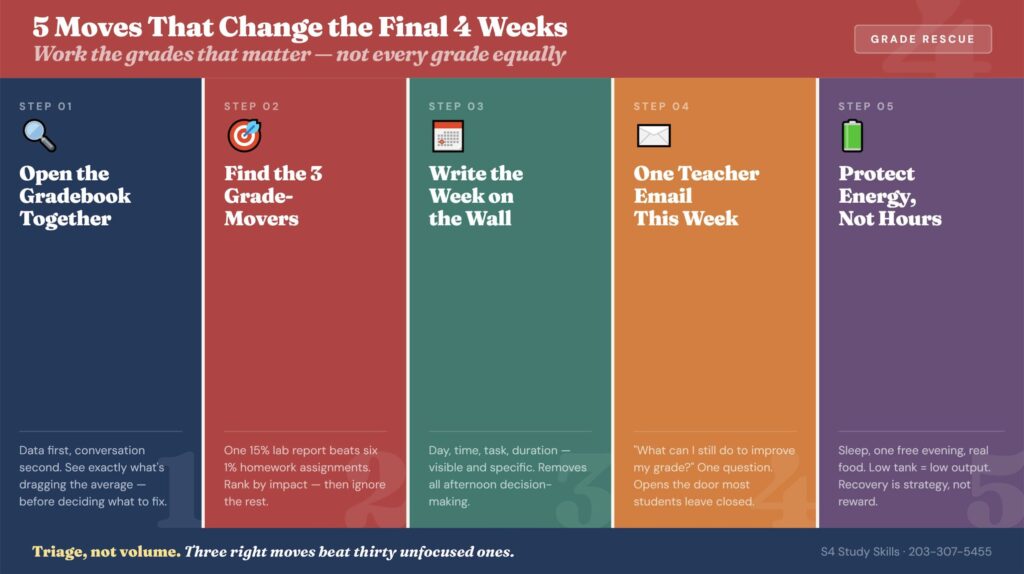
5 Strategies to Rescue the Final 4 Weeks
These strategies work for any student who’s checked out, whether they have ADHD, are generally disorganized, or are simply running on empty after a long year.
-
Start with the gradebook audit, not a lecture.
Before any conversation about effort or motivation, sit down together and pull up the online gradebook for every class. Write down three things for each subject: current grade, any missing assignments, and what percentage the final exam counts.
This does two things. First, it replaces the vague anxiety of “I’m behind” with specific, manageable data. Second, it often reveals the situation is less dire than either of you thought. Most students we work with in Fairfield and Westchester counties discover they have 2–3 key assignments dragging down their average, not the catastrophe they imagined.
-
Identify the 3 highest-impact moves, and ignore the rest.
Not every assignment matters equally. A missing lab report worth 15% of the final grade matters more than six missing daily homework assignments worth 1% each. Help your student rank the remaining work by one criterion: what will move my grade the most?
Then build the next two weeks around those 3 moves. Everything else gets maintenance effort only. This is triage, and it’s one of the most important executive function skills a student can learn.
-
Replace vague goals with a visible weekly plan.
“I’ll catch up this weekend” is not a plan. A plan looks like this:
- Monday 4:00–4:45: Finish chemistry lab report (worth 15%)
- Tuesday 4:00–4:30: Email English teacher about missing essay resubmission
- Wednesday 4:00–5:00: Start history project outline (due May 9)
Write it on a whiteboard, a printed sheet, or a shared Google Doc. The key is that the plan is external, visible, and specific enough that your student doesn’t have to make decisions about what to do each afternoon. Decision fatigue is the enemy of execution in the final weeks.
-
Send one teacher an email this week.
Teachers want to help students who ask. A short, honest email from your student: “What can I still do to improve my grade before the quarter ends?” opens a door that most students leave closed out of avoidance or embarrassment.
This email accomplishes three things: it signals effort to the teacher, which matters for borderline grade decisions. It clarifies which remaining work actually matters, and it gives your student a specific action plan from the person who controls the grade. One email to one teacher this week. Not five. Just one for the class where the grade is most recoverable.
-
Protect energy instead of adding pressure.
Your student’s tank is low. Adding more demands, more reminders, and more consequences will produce more avoidance, not more action. The final four weeks should involve reducing load where possible:
- Drop or pause non-essential extracurricular commitments if the grade situation is serious
- Protect 8 hours of sleep. Cognitive performance falls off a cliff with sleep deprivation, and it’s the first thing students sacrifice when they’re behind
- Keep one evening per week completely free of academic work. The recovery prevents the weeknight burnout that leads to weekend crashes
- Feed them well. Protein-forward meals improve focus and sustained attention more than any productivity app

What About Finals?
Finals are coming, and they matter. But here’s the counterintuitive truth: getting caught up on missing work often matters more than finals prep right now.
For most students, recovering one or two zeros from missing assignments will improve their final grade more than acing the final exam. The gradebook audit from Strategy 1 will reveal exactly where this is true for your student.
After the most urgent grade recovery work is addressed, finals preparation becomes easier to approach with clarity and structure. At successfulstudyskills4students.com, we share practical strategies for creating study calendars, using active study methods, and balancing preparation across multiple exams.
The Parent Role: Consultant, Not Controller
As the school year winds down, it’s easy for parents to slip into full management mode by checking grades daily, following up on every assignment, and overseeing each study session. The urgency is real, especially when deadlines are close, and grades feel fragile.
This stretch of the year also gives students a valuable opportunity to build ownership. Learning how to prioritize, plan ahead, communicate with teachers, and manage time prepares them for the independence required in college, where those responsibilities will rest entirely on them.
The Strategic Consultant approach:
- Help build the plan once (together, not for them)
- Agree on one check-in per day: “What did you work on today?” and keep it under 5 minutes
- Provide the environment: quiet space, snacks, and rides to the library
- Validate the difficulty: “This is a hard stretch. What’s one thing I can take off your plate?”
- Resist the urge to intervene between check-ins unless they ask for help
What to avoid:
- Daily grade monitoring that becomes surveillance
- Comparing them to siblings or peers
- Removing all social time as punishment for falling behind
- Lecturing about consequences they already understand
When the Pattern Repeats Year After Year
If your family goes through this cycle every spring, with late assignments, falling grades, and promises that next year will be different, your student may need stronger executive function skills. Challenges with planning, organization, and time management often continue until those skills are taught directly.
Executive function skills develop over time, but many students need clear instruction and practice to build them. Skills like planning ahead, staying organized, managing time, and following through can be taught, practiced, and improved.
Our Essential Study Skills and Executive Function Workshop helps students build those skills before the next school year begins. In three sessions over 4.5 hours, students learn simple systems for planning, organizing work, and managing school demands with more confidence.
Students start the school year with practical tools already in place, so they are better prepared when the workload begins.
Call 203-307-5455 to learn about the August workshop or to schedule an executive function coaching consultation. There are still four weeks of school left, enough time to stabilize this year and start planning for a different kind of next year.


Frequently Asked Questions
Is four weeks enough time to raise a grade?
In most cases, yes, especially if missing assignments are the primary issue. Completing two or three missing assignments that carry significant weight can move a grade by a full letter in some classes. The gradebook audit reveals exactly where recovery is possible.
My teen says they “don’t care” about grades anymore. What should I do?
“I don’t care” almost always translates to “I’m overwhelmed, and I’ve given up on figuring this out.” Respond to the overwhelm, not the words. Start with the gradebook audit. Seeing the actual situation often reignites engagement because the path forward becomes visible.
Should I email my teen’s teachers for them?
For middle schoolers, a parent email is appropriate. For high schoolers, coach them through drafting the email themselves. Self-advocacy is an executive function skill, and teacher communication is one of the strongest predictors of college success. Help them write it. Let them send it.
How do I help without becoming the Homework Police again?
Build the plan together, then step back. One check-in per day. Provide structure (environment, schedule, logistics), not surveillance. The goal is for your student to learn to manage themselves with support, not perform under supervision.
My student has ADHD. Are these strategies different for them?
The strategies above work for ADHD students with a few modifications: shorter task blocks (25 minutes instead of 45), external timers, body doubling during work sessions, and the gradebook audit done out loud rather than silently on a screen. Last week’s blog post covers ADHD-specific executive function strategies in more depth.
What summer programs help prevent this cycle?
Our August Essential Study Skills and Executive Function Workshop teaches the planning, organization, and study systems that make the next school year manageable from day one. Students build these skills without the pressure of grades, then apply them immediately in September. Call 203-307-5455 for details and registration.
S4 Study Skills provides executive function coaching, study skills tutoring, and SAT/ACT preparation for families in Fairfield County (Greenwich, Darien, Westport, New Canaan) and Westchester County (Scarsdale, Chappaqua, Armonk). Call 203-307-5455.
