

Spring break for most Fairfield County families falls the week of April 13–17 this year. AP exams start May 4. That leaves roughly three weeks between the end of break and the first morning exam session. How your student uses this week shapes whether May feels manageable or catastrophic.
The instinct is to go one of two directions: ignore academics entirely (“they need a real break”) or push a punishing study schedule (“we’re running out of time”). Neither works well. The students we coach at S4 use spring break as a diagnostic reset, which is a structured but moderate week that identifies exactly where they stand and builds the plan for the final stretch.
Should My Student Study During Spring Break?
Yes, but with boundaries. Spring break is not the week for marathon study sessions or learning new material. It is the week for taking stock. Students who use breaks strategically spend 1.5–2.5 hours per day on focused AP review, and spend the rest of the week resting, exercising, and recharging for the May push.
The goal for break week is diagnostic, not comprehensive. Your student should emerge from the week knowing three things: which AP subjects feel solid, which units within weaker subjects need the most review, and what their realistic study calendar looks like for the next three weeks.
What’s the Best Spring Break Study Plan for AP Exams?
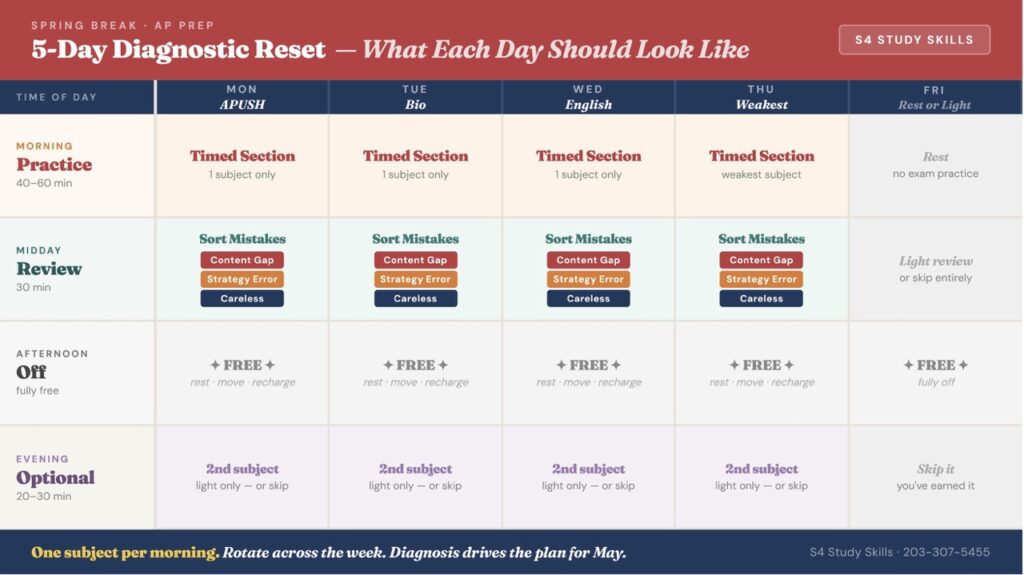
A productive spring break follows a simple daily rhythm.
Morning: one timed practice section (40–60 minutes) in one AP subject.
Midday: 30 minutes reviewing results and categorizing errors.
Afternoon: free.
Evening: optional light review of a second subject (20–30 minutes), or skip it entirely.
Rotate subjects across the week. If your student is taking AP US History, AP Biology, and AP English Language, the schedule might look like:
- Monday – APUSH practice,
- Tuesday – Bio practice,
- Wednesday – English practice,
- Thursday – return to weakest subject,
- Friday – rest or light review only.
The practice sections serve as a diagnostic. After each one, your student should sort their missed questions into three categories: content gaps (didn’t know the material), strategy errors (knew it but misread the question or ran out of time), and careless mistakes (knew it, understood the question, still got it wrong). Each category requires a different fix in the final three weeks.
How Do I Set Up the Right Structure Without Becoming the Homework Police?
Parents who set up the environment without managing the content get the best results. Before the break starts, sit down together and agree on two things: what time of day study happens and how long each session lasts. Then step back.
Your role during break is logistics, not enforcement. Make sure the house is quiet during study time. Keep snacks stocked. Drive to the library if your student works better outside the home. If they finish early, resist the urge to add more. If they skip a day, note it privately but don’t escalate, as one missed day during break is not a crisis.
The shift from “Homework Police” to “Strategic Consultant” that we teach at S4 matters most during high-pressure windows like this. A consultant provides the framework and then trusts the person to execute. That trust, even when imperfect, builds the independence your student needs for May’s exams, and for college after that.
What About Students with ADHD?
ADHD students benefit from an even more structured break schedule. The key adjustments: shorter study sessions (25–30 minutes instead of 45–60), a visual timer, a physical change of location between subjects, and a clear reward after each session. Body doubling, studying in the same room as a parent or sibling who is also working, can significantly improve task initiation for ADHD students.
For ADHD students, the diagnostic element of the break week is especially valuable. Many ADHD students overestimate what they know (“I remember that unit”) and underestimate what they’ve forgotten. A practice section reveals the truth without judgment. The data from that practice section becomes the study plan, which externalizes the planning that ADHD brains struggle to generate internally.
Spring Break Prep vs. Burnout: Where’s the Line?
| Approach | Productive Reset |
Burnout Trap |
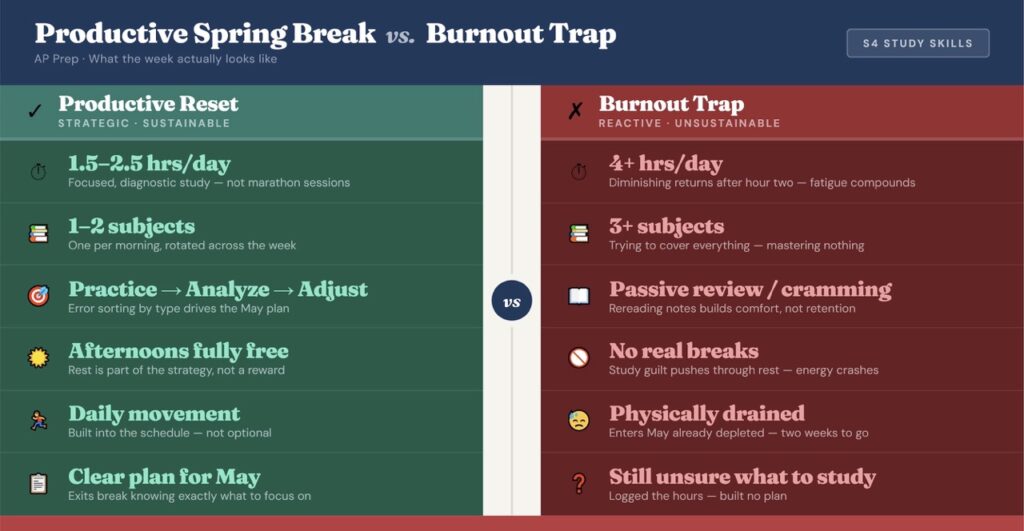
| Daily study hours | 1.5–2.5 hours | 4+ hours |
| Subjects per day | 1–2 (rotate) | 3+ (cram everything) |
| New content | None—diagnostic only | Trying to learn missed units |
| Break time | Full afternoons free | Study until dinner |
| Physical activity | Daily movement is built in | Desk all day |
| Parent role | Set structure, step back | Hovering, quizzing, checking |
If your student finishes the break feeling rested and clear about what to focus on, the week was a success. If they finish exhausted and resentful, the final three weeks will suffer regardless of how many hours they logged.
Frequently Asked Questions: Spring Break and AP Prep
Is spring break too late to start studying for AP exams?
If your student has been engaged in their courses all year, spring break is an excellent time to begin focused review. If they have significant content gaps from the fall semester, the break should be used for triage, identifying the highest-weight units and building a realistic plan for what can be covered in three weeks.
How many hours per day should my teen study during spring break?
1.5–2.5 hours of focused, diagnostic study per day. Quality matters more than quantity during break week. Marathon sessions produce diminishing returns and eat into the rest that makes the final three weeks sustainable.
Should my student take a full practice exam during spring break?
Not a full exam. One timed section per day is sufficient for diagnostic purposes. Save full-length practice exams for the final two weeks before testing, when building stamina matters more than identifying gaps.
My student refuses to study during break. What should I do?
Start with a conversation about their confidence level for each exam. Many students who resist studying are actually anxious. The avoidance is a coping mechanism, not laziness. Offer a low-stakes entry point: “Would you be willing to take one 30-minute practice section to see where you stand?” Data often motivates, where pressure does not.
What if my student is also prepping for the May SAT?
If the May 2 SAT is on the calendar alongside AP exams, spring break should split time: 60% AP diagnostic work, 40% SAT review. Prioritize the test that matters most for your student’s specific goals. We cover the full SAT-AP-Finals triage in detail in next week’s post.
S4 Study Skills provides executive function coaching and academic support for students in Darien, Greenwich, Westport, New Canaan, Scarsdale, Chappaqua, and Armonk. Call 203-307-5455 to schedule a spring consultation.

