

Your child was assigned a 200-page novel for summer reading. They have a working laptop, a phone in their pocket, and a free ChatGPT account. In about 11 seconds, they can pull up a chapter-by-chapter summary, a character breakdown, a list of themes, and a rough draft of whatever essay is due in September.
Most kids could do this. The harder part for parents is knowing whether they will, and what to do when they do.
The temptation is nothing new. SparkNotes and Cliffs Notes were doing a slower version of this for decades. What has changed is the speed, the polish, and how genuinely hard it now is to tell a student’s own thinking apart from a machine’s. This post covers what summer schoolwork looks like now, how to spot the difference between help and a shortcut, and how to talk with your teen about it without turning July into a standoff.
QUICK FACTS
- 54% of US teens say they have used AI chatbots for schoolwork (Pew Research Center, 2025 survey).
- About 1 in 10 teens do all or most of their schoolwork with a chatbot’s help.
- 59% of teens say AI cheating is a regular occurrence at their school.
- 96% of college instructors believe at least some students cheated in the past year, up from 72% in 2021.
How are teens actually using ChatGPT for schoolwork in 2026?
More than half of them are using it. In a Pew Research Center survey of teens ages 13 to 17, 54% said they have used AI chatbots to get help with schoolwork. About one in ten said they do all or most of their schoolwork with a chatbot’s help.
For ChatGPT specifically, the numbers climbed fast. The share of teens using it for schoolwork doubled in a single year, from 13% in 2023 to 26% in 2024. Teens also see the darker side: 59% say cheating with AI is a regular occurrence at their school.
This has quietly become normal. For a lot of kids, AI is now part of everyday schoolwork.
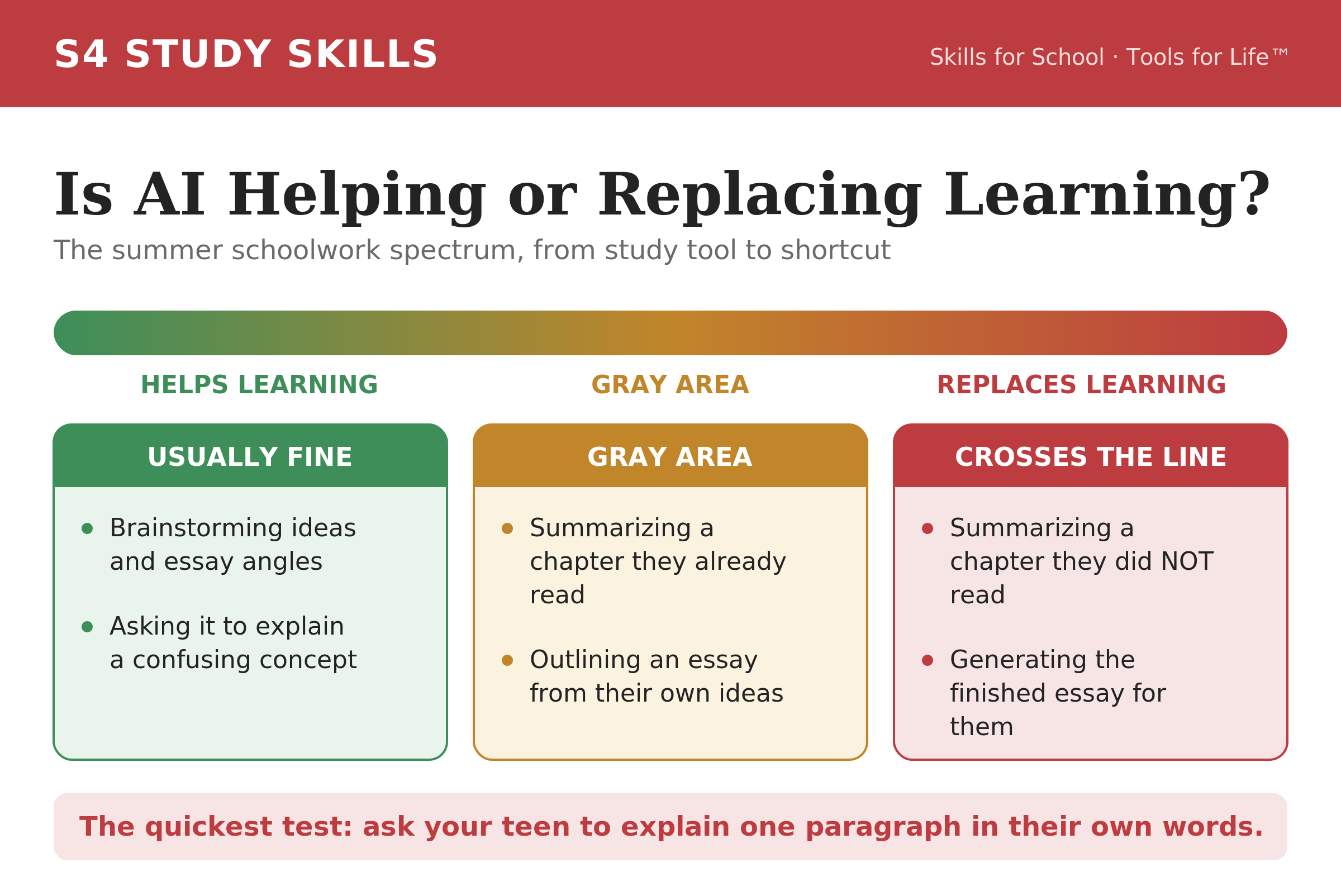
But “using ChatGPT” is not one thing. It runs along a spectrum, from genuinely helpful to outright cheating, and most of the important decisions happen in the messy middle.
| How your teen is using it | Where it falls |
|---|---|
| Brainstorming ideas or essay angles | Usually fine |
| Asking it to explain a confusing concept | Usually fine |
| Summarizing a chapter they already read | Gray area |
| Building an essay outline from their own ideas | Gray area |
| Summarizing a chapter they did NOT read | Problem |
| Generating the finished essay word for word | Cheating |
The trouble is that most parents only picture that last row. Meanwhile the real judgment calls are happening two and three rows up, where the line between a study tool and a shortcut gets blurry.
How do I know if my teen is using ChatGPT to cheat?
The most reliable signal is whether your child can explain what they wrote in their own words. There are also tells in the writing itself, and they are worth knowing.
There are tells in the work. A few to watch for:
- Vocabulary that does not sound like how your child normally talks or writes
- Transitions that are a little too smooth and polished for a first draft
- Generic content that could describe almost any book, with no specific detail from this one
- A flat, voiceless quality, as though no real person had an opinion about the story
The single best test costs nothing. Ask your child to explain one paragraph they wrote in their own words. If they wrote it, they can talk about it. If a chatbot wrote it, they usually cannot.
One warning about AI detectors: do not trust them. The tools that claim to catch AI writing are unreliable. They flag real student writing as fake, and they miss plenty of AI text, especially once it has been edited. Casey Cuny, California’s 2024 Teacher of the Year, said it plainly: “Anything you send home, you have to assume is being AI’d.” Teachers already know. Detection software is not the answer, and conversation is.
Is it ever okay for my child to use ChatGPT for schoolwork?
Yes, with rules. The useful question is not “AI or no AI.” It is “is this a tool or a replacement?”
A tool helps your child do the thinking. A replacement does the thinking for them. Same technology, completely different result.
We have lived through this with every new classroom technology, and the pattern rhymes.
| Technology | A tool when… | A replacement when… |
|---|---|---|
| Calculator | It handles the arithmetic so your child can focus on the harder concept | They never learned what the numbers actually mean |
| Spell-check | It catches typos in a sentence your child wrote | It writes the sentence for them |
| Wikipedia | It points them to sources and background to dig into | They copy it and call it their own work |
| ChatGPT | It explains, quizzes, or brainstorms alongside your child | It produces the work they turn in |
Students themselves feel the line. In a 2023 study of US high schoolers, large majorities across both private and public schools said AI should never write an entire paper. They were far more comfortable using it to explain a concept or spark ideas. Knowing where your child already draws that line is a good place to start.
Where do most teachers land in 2026? Roughly here: using AI to understand the material is usually allowed, and using AI to produce the finished product is usually not. Every teacher is different, which is exactly why your child needs to know each teacher’s actual policy.
Local policies vary widely too. Greenwich Public Schools has adopted formal guidelines that permit AI use within clear limits while barring students from passing off AI-generated work as their own. Westport is taking a slower, guardrails-first approach. Many Fairfield County and Westchester districts, including Darien and Scarsdale, are still writing their rules or leaving them to individual teachers. The policy your neighbor’s child follows may not be the one at your child’s school.
What about my teen with ADHD or executive function challenges?
For students with ADHD or executive function struggles, AI is genuinely useful as scaffolding and genuinely risky as a crutch. Both are true, and the difference matters more for these kids than for almost anyone.
Start with the legitimate use. A student who freezes at a blank page can ask a chatbot to help break a big assignment into smaller steps. A student who keeps losing the thread can ask it to re-explain a dense paragraph a different way. That is scaffolding, and it gets them into work they are fully capable of doing.
Now the risk. When the AI stops helping your child begin and starts doing the task itself, support quietly turns into dependence. The skill never gets built, because the tool keeps rescuing them right before the hard part.
The struggle is where the skill gets built. A little productive frustration is doing the real work.
There is also a longer game here. A student who leans on AI to get through every high school assignment can arrive at college without the executive function skills that freshman year demands. Instructors are already feeling it: in a 2024 Wiley survey, 96% of college instructors believed at least some of their students had cheated in the past year, up from 72% in 2021. If AI has quietly done the planning, drafting, and revising for four years, freshman fall becomes a very hard wake-up call. For these students the goal is not zero AI. It is building the muscle now, while the stakes are still low.
What is the right conversation to have with your teen this summer?
The best approach is a calm, curious conversation rather than a confrontation. Open with an accusation and your child will get defensive and go quiet, and you will learn very little.
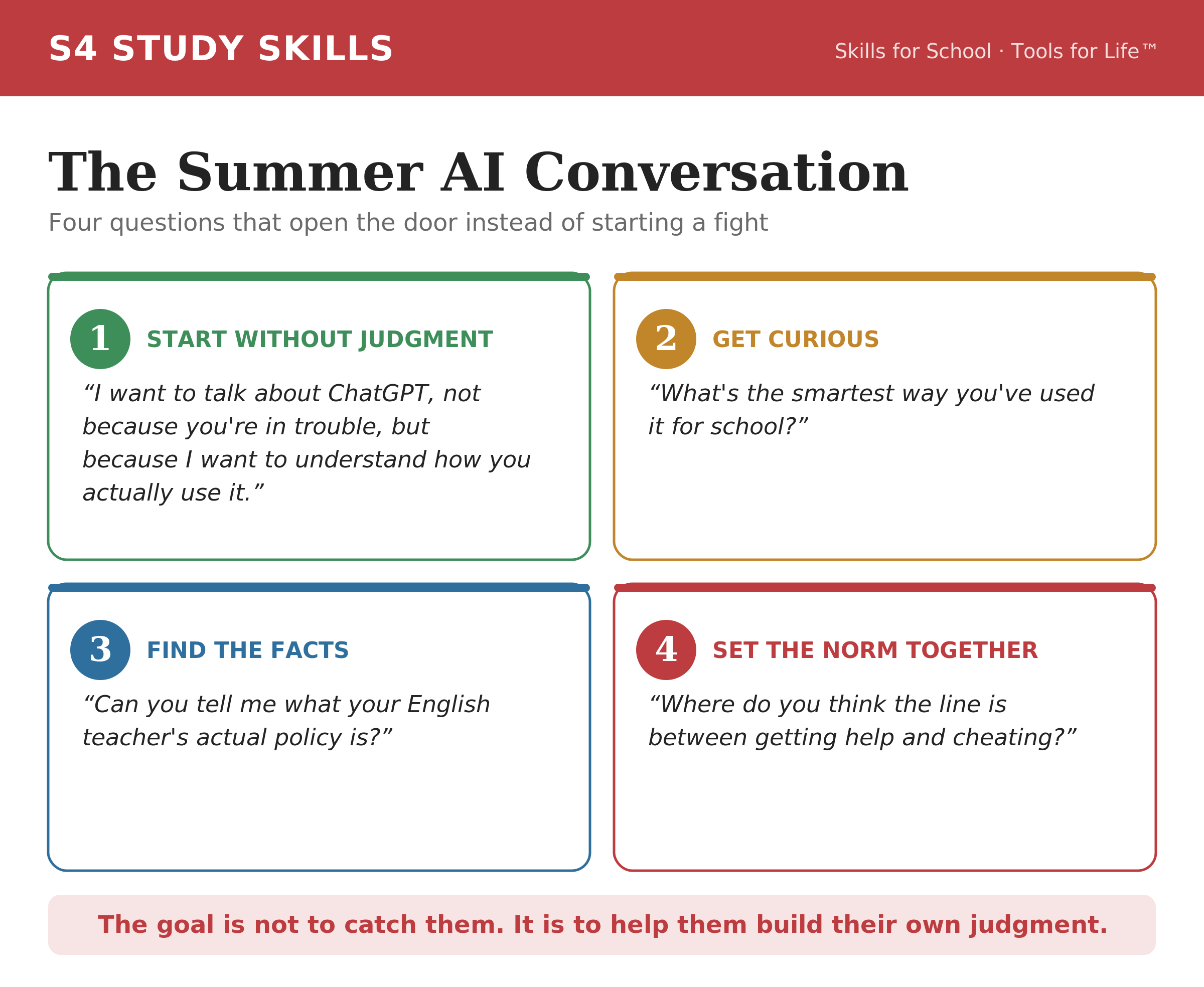
Summer is a good moment for it, because nothing is due tomorrow and no one is in trouble yet. Lead with curiosity, and let your teen do most of the talking. Four questions tend to open the door:
- Open without judgment: “I want to talk about ChatGPT, not because you’re in trouble, but because I want to understand how you actually use it.”
- Get genuinely curious: “What’s the smartest way you’ve used it for school?”
- Find the facts: “Can you tell me what your English teacher’s actual policy is?”
- Set the norm together: “Where do you think the line is between getting help and cheating?”
The goal is not to catch your child doing something wrong. It is to help them build their own judgment, so that when you are not looking over their shoulder, they still make a call they can be proud of.
What can my child actually learn this summer without using AI as a shortcut?
Quite a lot, and most of it is the exact set of skills a chatbot cannot build for them.
Real reading and real discussion. Reading a whole novel and then talking about it, with a parent, a sibling, or a coach, builds comprehension and the ability to hold an argument. A summary cannot do that.
Note-taking by hand. Research on note-taking suggests that writing by hand pushes students to process ideas and put them in their own words, rather than transcribe them word for word (Mueller and Oppenheimer, 2014). The effort is the point, not a side effect.
Writing without AI. Drafting a clumsy first paragraph, getting stuck, and pushing through anyway is how writing skill is actually built. The discomfort is not a bug in the process. It is the training.
This is the work we do with students at S4 every summer. Our summer reading and writing support and our executive function coaching are built around exactly this idea: helping your child do the thinking, so the skill is theirs to keep. If your child is heading into a demanding year, the weeks before it starts are the window to build these habits, before the pressure arrives.
Frequently asked questions
Can teachers tell if a student used ChatGPT?
Often, yes, though usually through conversation and their knowledge of a student’s normal work, not through detection software. Many teachers now assign writing in class specifically so they can see a student’s real voice and thinking.
What percentage of students use AI for homework?
In a 2025 Pew Research Center survey, 54% of US teens ages 13 to 17 said they had used AI chatbots to help with schoolwork. About one in ten said they do all or most of their schoolwork with a chatbot.
Is using ChatGPT to summarize a book cheating?
It depends on whether your child read the book. Using a summary to review something they actually read is a study aid. Using one to replace assigned reading is a shortcut around the point of the assignment, and most teachers would call that cheating.
How can I block ChatGPT on my child’s devices?
You can restrict access through router settings, device-level parental controls, or school-managed device settings, but blocking is rarely a full fix. Kids can still reach these tools on phones and friends’ devices. Clear expectations tend to work better than technical blocks alone.
Will using AI in high school hurt my child in college?
It can, if it replaces skill-building instead of supporting it. Students who rely on AI to do their work may reach college without the writing and executive function skills that freshman courses assume they already have.
How do schools detect AI-written essays?
Some schools use detection software, but many educators consider it unreliable. Increasingly, schools lean on in-class writing, knowing a student’s baseline work, and asking students to explain or defend what they wrote.
NOT SURE WHERE YOUR CHILD STANDS?Call us at 203-307-5455 for a 30-minute diagnostic conversation. We will help you decide what (if anything) needs intervention this summer. We work with families across Fairfield County and Westchester, both in person and remotely. |

