

QUICK FACTS
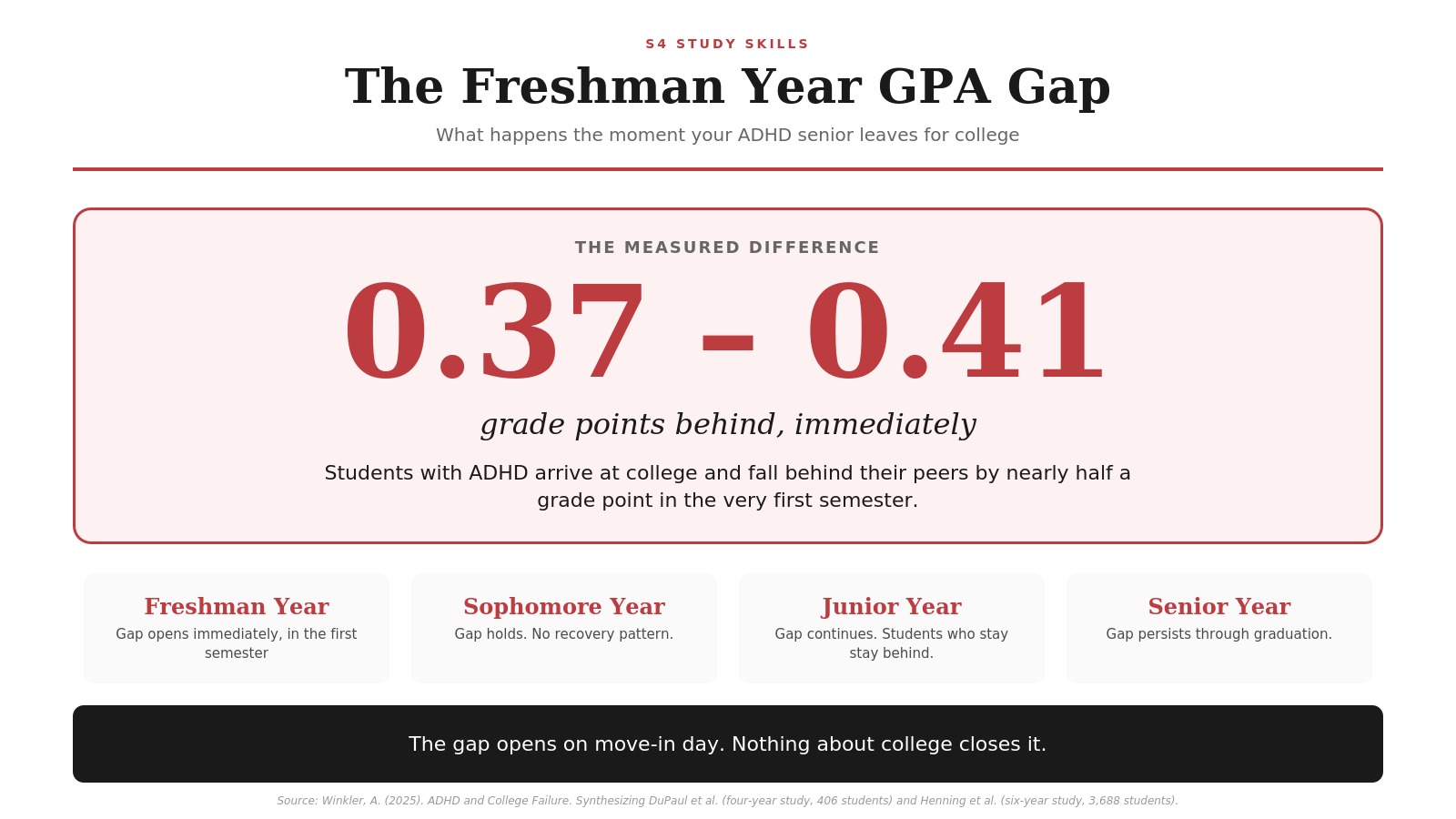
- Students with ADHD fall behind by 0.37 to 0.41 GPA points in the very first semester of college (Winkler, 2025)
- The gap opens immediately and does not close over four years
- Untreated ADHD students are 49% more likely to drop out
- Students with disabilities overall are 58.7% more likely to drop out (Education Data Initiative)
- Federal law changes at 18: high school IEP and 504 plans do not transfer to college
- The frontal lobe, which controls executive function, continues developing into the mid-20s
Your senior just graduated. Their high school IEP or 504 plan got them extra time on tests, a quiet room for finals, weekly check-ins with the learning specialist, and a guidance counselor who watched their grades.
None of those things transfer automatically to college.
Most parents do not learn this until the first semester GPA drops. By then a measurable gap has already opened, and the research is clear that it will not close.
Students with ADHD arrive at college and immediately fall behind their peers by nearly half a GPA point. According to a 2025 report by Aaron Winkler, MD, the gap opens in the very first semester and persists through all four years of college.
How much do ADHD students actually fall behind in college freshman year?
Students with ADHD fall behind by 0.37 to 0.41 GPA points, and the gap opens in the very first semester. It does not close over four years of college.
The research behind the number
Dr. Winkler is a board-certified psychiatrist who founded the adult ADHD clinic at Stanford University. His 2025 report synthesizes data from two major longitudinal studies of college students: DuPaul and colleagues’ four-year study of 406 students, and Henning and colleagues’ six-year study of 3,688 students. Both studies used official academic records rather than self-reported grades.
The pattern is unambiguous. Students with ADHD arrive at college and fall behind immediately. The gap holds semester after semester.
Why the comparison matters
These are often the same students who did fine in high school. A student who graduated with a 3.5 GPA and a stack of honors classes can find themselves with a 2.8 by December of freshman year. The parent looking at that transcript is often confused.
Nothing about the student has changed. What has changed is everything around them.
Why do ADHD students who did well in high school crash in college?
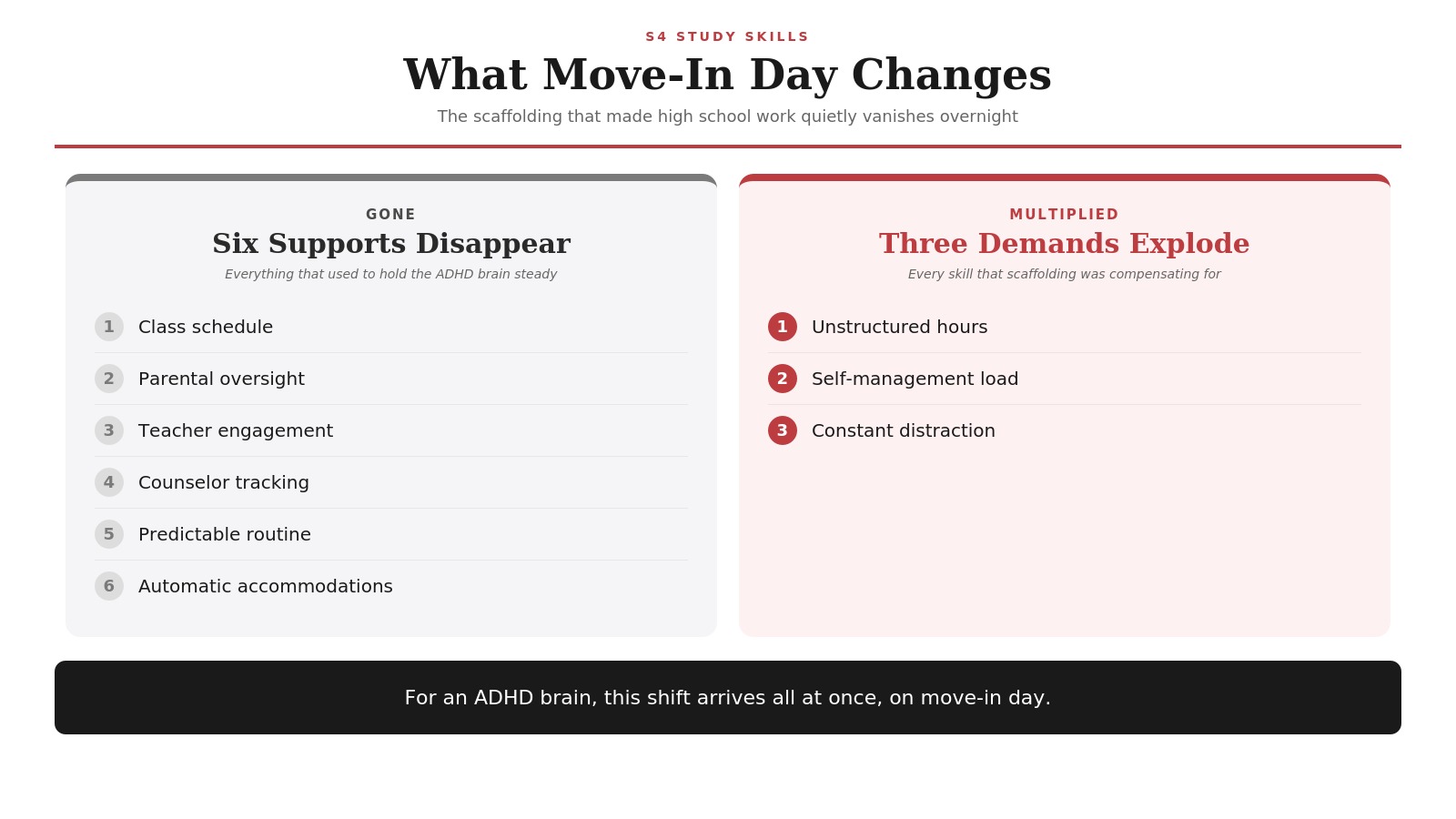
The supports that made high school work quietly disappear the day of move-in. The demands of college life require exactly the skills those supports were compensating for.
Six supports that disappear at move-in
| The support | In high school | In college |
| Class structure | 7:45 AM to 2:45 PM, same room, same schedule, every day | Classes might meet twice a week, at different times, with hours of unstructured time between them |
| Parent oversight | You knew what was due, when, and whether they had started | No one is checking whether they packed the textbook or set an alarm for the 8 AM lab |
| Teacher check-ins | Teachers see the same students every day and often notice when something is wrong | Professors see students two or three times per week for 75 minutes and rarely notice anything |
| Guidance counselor monitoring | Someone is watching the transcript in real time | No one is watching except the student |
| Predictable schedule | Same lunch, start time, end time, and bell every day | Every day looks different |
| Automatic accommodations | Extra time, quiet room, reduced distractions built in | Nothing carries over |
Three demands that multiply
| The demand | What changes overnight |
| Unstructured time | A typical Tuesday has two 75-minute classes and roughly nine hours with no plan. Every hour has to be actively filled with a decision. Most freshmen cannot solve that puzzle in the first semester. |
| Self-management | Sleep, meals, exercise, medication, laundry, money, appointments, deadlines. All of them now live in the student’s head. |
| Distraction | Roommates, social plans, notifications, thousands of peers also unmoored from external structure. The ADHD brain is uniquely vulnerable, and college is designed around it. |
Do high school IEP and 504 accommodations transfer to college?
No. Not automatically, not partially, not eventually.
This is the single most important legal reality that most families do not learn until it is too late.
The legal shift at 18
In K-12, the Individuals with Disabilities Education Act (IDEA) placed the burden on the school to identify students with disabilities, evaluate them, and create the IEP or 504 plan that got them through class. Your child was largely a passenger in the process. The school found the need, wrote the plan, and monitored the outcomes.
In college, the framework changes entirely. Federal law shifts from IDEA to the Americans with Disabilities Act (ADA) and Section 504 of the Rehabilitation Act. Under these laws, the student is responsible for:
- Self-disclosing that they have a disability
- Providing recent documentation (many colleges require testing within the last three years)
- Contacting the college disability services office to request accommodations
- Following up if the accommodations do not arrive
- Advocating for themselves with every professor, every semester
Every step in that chain requires the student to make a decision, take an action, and follow through. Each one is exactly the kind of self-advocacy an ADHD brain struggles with. Any one of them can stall.
The timeline problem most families miss
Some colleges require accommodation requests to be submitted weeks or even months in advance of each semester. A student who arrives at college and figures things out in October may not have accommodations available for the December finals when they most need them.
What can parents of rising college freshmen do this summer?
Start now. August is too late.
The summer between senior year and freshman year is the last window for building skills before the environment gets harder. Two parallel checklists are worth working through with your senior: skills and paperwork.
The summer skill-building checklist
- Time management practice. Give your senior full ownership of their weekly schedule for two weeks. No reminders. No wake-up calls. Let them own the consequences of every missed alarm and forgotten commitment. This is uncomfortable to watch. It is also the fastest way to build the muscle they will need in September.
- Self-advocacy practice. This summer, they make the appointments. All of them. Call the doctor. Email the academic advisor. Talk to the summer job manager. Every conversation they have without you stepping in is a rep.
- Medication management. If you have been managing the ADHD medication (refills, timing, tracking), the transfer of that responsibility needs to happen now, in the summer. The day before move-in is too late.
- Sleep schedule reset. A senior who has been sleeping until noon in July is going to physically struggle with 8 AM classes in September. Rebuilding the sleep pattern takes weeks.
- Money management. A checking account, a debit card, a monthly budget. If your senior does not know how much rent, groceries, and books cost, they will not know when they are running out.
The accommodations checklist
- Contact the college’s Office of Disability Services before move-in. Do this in July, before the paperwork gets buried in a hundred other things.
- Gather updated documentation. Many colleges require neuropsychological testing within the last three years. If your child’s testing is older, updated testing needs to be scheduled. This can take weeks.
- Submit the accommodation request before classes start. Read the college’s own requirements carefully. Some schools require the request in advance of each semester. Others accept mid-semester requests, but by then the term is underway.
- Schedule a meeting with the disability services office in the first two weeks of school. Face-to-face contact matters. It builds the relationship your senior will need if things go sideways.
When is it too late to build these skills?
It is not too late. Timing determines what is realistic.
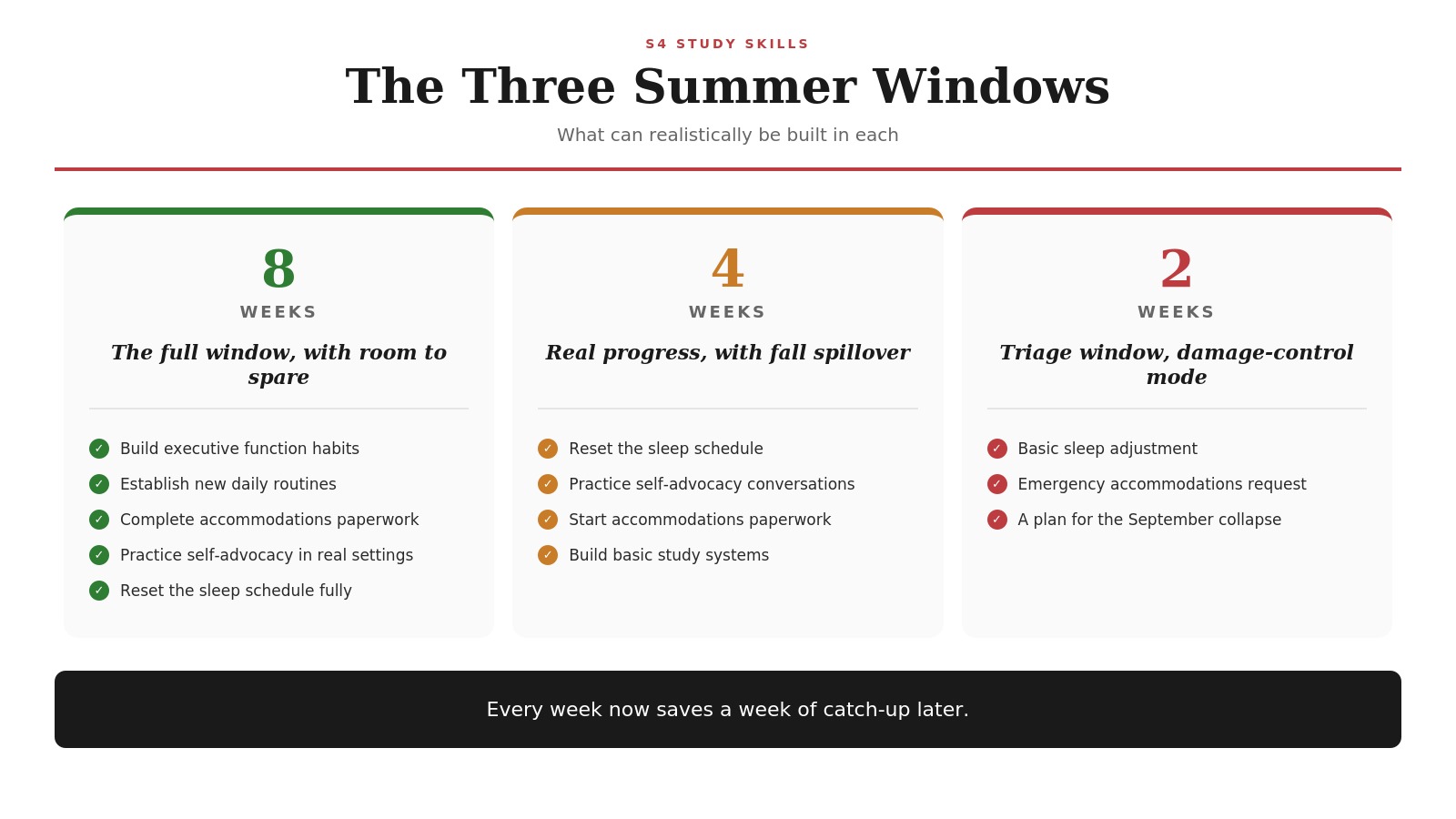
What eight weeks can build
Eight weeks of summer work (June to August) can build meaningful executive function skills, establish new routines, and complete the accommodations paperwork with time to spare. This is what the summer window is for.
What four weeks can build
Four weeks of summer work (starting in late July) can still make real progress. Sleep schedules reset. Self-advocacy conversations happen. Accommodations paperwork gets started, though it may need to continue into the fall.
What two weeks can do
Two weeks before move-in is enough time for triage. The focus shifts from building foundations to preparing for the reality that some collapse will happen in September, and having a plan for what to do when it does.
How S4 helps
Our Crash Course in College Study Skills is a focused summer program that builds the foundational skills rising freshmen need before they arrive on campus. Four to six sessions across the summer covering workload management, weekly planning, exam preparation, and self-advocacy.
The Success in College program continues remotely through the first semester, designed for the moments that matter most: navigating disability services, midterms, and the first crisis on campus.
What if my child refuses to talk about this?
Many rising freshmen resist this conversation because they are already anxious about the transition, and any conversation that surfaces the challenges makes the anxiety worse.
The framing that tends to open the door describes the environment they are about to enter, rather than something about them.
Try something like this:
“I trust you. I also know what changed for me freshman year that nobody warned me about. Can I tell you the two or three things I wish someone had told me?”
This works because it takes the pressure off the student. Instead of accusing, you are sharing information they can accept, dismiss, or use later. Many teenagers cannot receive a direct question about their own weaknesses. Most can receive a story from a parent about a general pattern.
If the conversation continues to fall apart, an outside voice sometimes helps. An executive function coach, an ADHD-specialist therapist, or a program like ours can sometimes reach a student in ways parents cannot. An outside adult can raise the same concerns without triggering the same defenses.
Frequently Asked Questions
Do ADHD students get accommodations in college?
Yes, if they request them and provide documentation. Unlike high school, colleges will not identify or accommodate a student with ADHD automatically. The student must self-disclose to the disability services office, provide recent documentation (typically neuropsychological testing within the last three years), and request specific accommodations. Common college accommodations include extended time on tests, quiet testing rooms, note-taking assistance, and priority registration for courses.
How do I help my ADHD teen prepare for college independence?
The summer between senior year and freshman year is the highest-impact window. Practice self-advocacy (have them make calls and appointments themselves), transfer medication management to their responsibility, establish a sleep schedule that will hold at college, and complete the college disability services paperwork before move-in. Structured programs like executive function coaching and ADHD-specific tutoring can accelerate this work by building the skills with feedback, not just advice.
What is the college dropout rate for ADHD students?
Untreated ADHD students are 49% more likely to drop out than their peers, according to Education Data Initiative statistics. Students with disabilities overall are 58.7% more likely to drop out. These numbers reflect what happens when the supports of high school disappear and the demands of college land at the same time.
Should my ADHD child take a gap year?
For some students, yes. A structured gap year can be genuinely useful. Unstructured gap years often make ADHD challenges worse. If you are considering this option, the decision should be based on your student’s specific situation rather than on general advice about ADHD and college.
How much do ADHD coaches cost?
ADHD coaching costs vary widely based on location, credentials, and format. Weekly one-on-one coaching typically ranges from $100 to $250 per session. Group programs and structured coursework programs generally cost less per hour. The value of coaching often depends less on price and more on the coach’s specific expertise with ADHD and executive function work, and whether the student engages consistently.
Does ADHD medication still work in college?
Yes, when taken consistently. The complication in college is consistency, and consistency depends on the systems that used to be provided by parents and school. A student who was reminded to take medication every morning by a parent may forget to take it at all. Prescriptions managed by parents can run out. Home pediatricians who write the prescriptions may be hard to reach from campus. These are logistical challenges that can be prepared for over the summer.
The GPA your child brings home next December will be shaped more by decisions made this summer than by their intelligence, effort, or high school transcript. Everything about the environment changes on move-in day. Every support vanishes. New demands land immediately.
The question is whether your senior arrives on campus prepared for that, or whether they arrive to figure it out under fire.

