
QUICK ANSWER
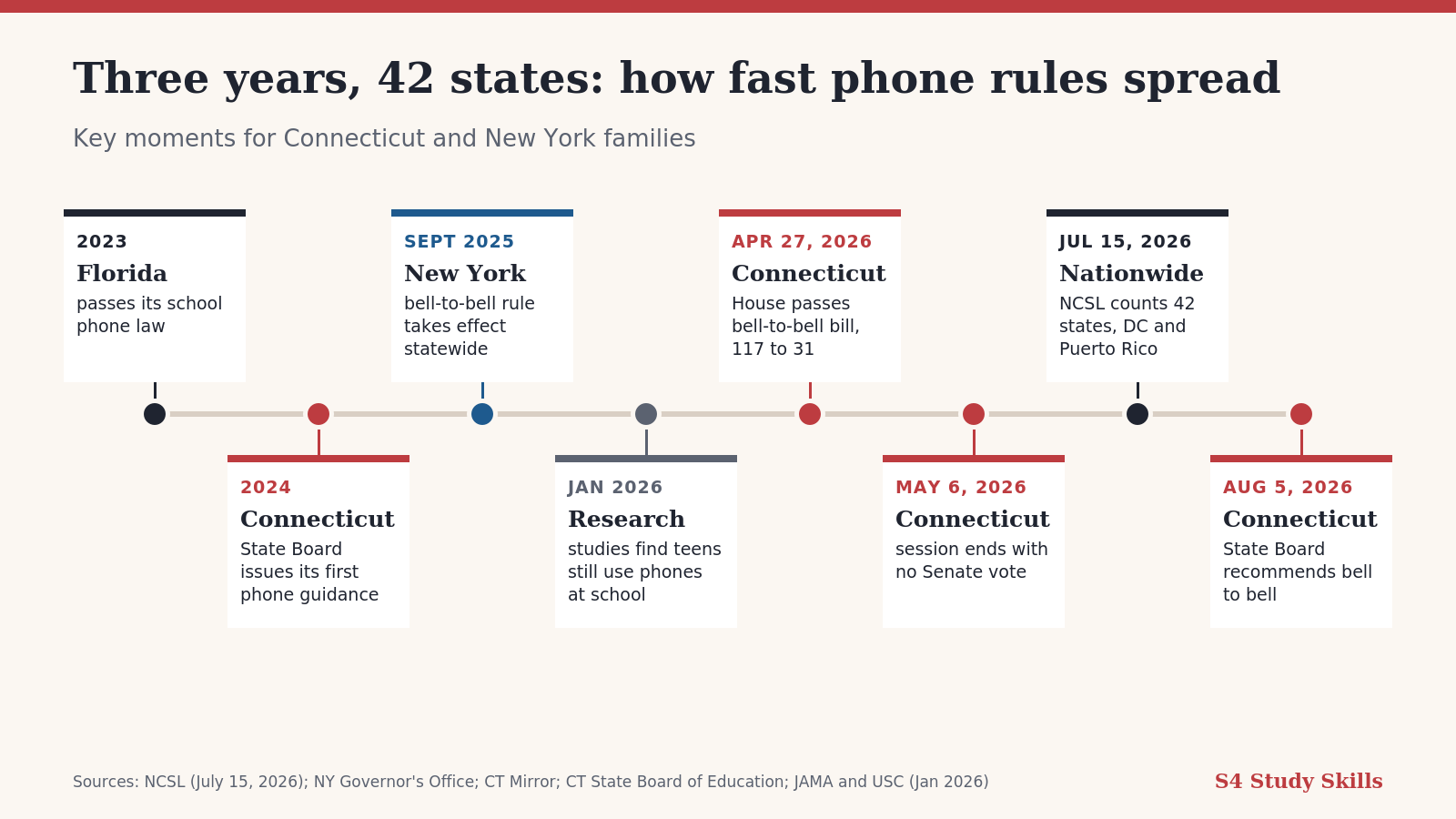
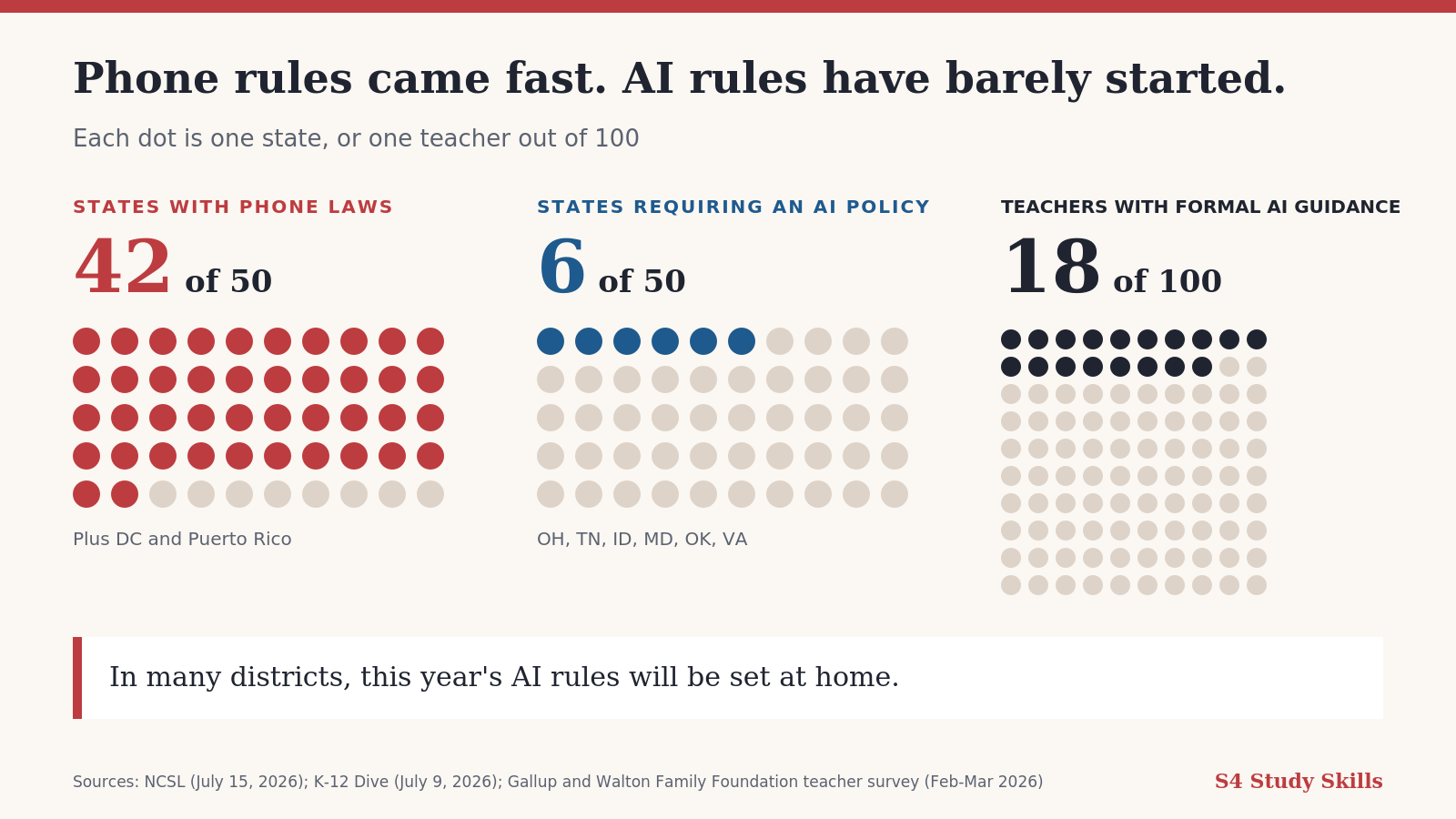
Nearly every public school in the country now has a phone rule. As of July 15, 2026, the National Conference of State Legislatures (NCSL) counted 42 states, plus Washington, DC and Puerto Rico, with laws on student cellphone use.
Connecticut is an exception, with no statewide requirement. A statewide bell-to-bell bill passed the House in April 2026 but never got a Senate vote. The state now offers guidance only, so each district decides. New York has required bell-to-bell limits in every school since the 2025-26 school year.
AI is a different story. More than 30 states have given schools AI guidance, but only a handful require districts to adopt a real AI policy. For now, the AI rules at home are mostly up to parents.
If your child’s phone now spends the school day in a pouch or a locker, you have watched one of the fastest shifts in school policy in years. It happened in almost every state at nearly the same time.
Connecticut and New York took two different paths, though. That can make comparing notes with a friend across the state line pretty confusing.
Meanwhile, a second question is sitting on your kitchen table: what are the rules for AI? That one has barely been answered at all.
Below is where things stand this fall, with links to every source so you can check them yourself.
PART 1: THE NATIONAL PICTURE
How many states have restricted phones in schools?
Most of them. As of July 15, 2026, NCSL counted 42 states, plus Washington, DC and Puerto Rico, with enacted laws on cellphone use in schools. Florida passed its law in 2023. Most other states acted in the three years that followed.
Why do the numbers online look so different?
You will see smaller numbers in other articles. That usually comes down to what each tracker counts. NCSL counts three kinds of laws:
- Policy laws that require districts to adopt a phone rule
- Guidance laws that ask the state to write advice for districts
- Funding laws that pay for storage, like pouches or lockers
A tracker that counts only full-day bans will land on a much lower number. Both can be accurate. They simply measure different things.
The national question has also changed. It used to be whether schools should limit phones. Now it is how far those limits should go.
Why did this happen so fast?
School leaders reported a problem on a large scale, and lawmakers from both parties agreed. In a federal School Pulse Panel survey from December 2024, 73 percent of public school leaders said cellphones had hurt students’ attention spans. Another 72 percent said phones had hurt student mental health.
A few other forces pushed in the same direction:
- Learning concerns. In that same survey, 53 percent of school leaders said phones had hurt academic performance.
- Health warnings. In 2023, the U.S. Surgeon General released an advisory on social media and youth mental health.
- Family support. A USC survey from fall 2025 found 93 percent of parents and 76 percent of teens supported somww32e kind of limit.
- Votes across party lines. Connecticut’s bell-to-bell bill, for example, passed the House 117 to 31 with support from both parties.
What do these rules generally look like?
Most fall into one of three models. Classroom-only rules limit phones during class. Bell-to-bell rules limit them for the whole day, including lunch and passing time. Secure storage rules add pouches, lockers or caddies. A fourth group of states, like Connecticut, offers guidance and lets districts choose.
The word “ban” can be misleading. In a RAND survey of principals from fall 2024, 95 percent of schools still let students bring phones to school. What changes is when students can use them.
Nearly every law also lists exceptions. New York’s law is a good example. Its required exceptions include:
- Use for schoolwork when a staff member allows it
- Managing a health condition
- Emergencies
- Translation needs
- Family caregiving, decided case by case
- Anything written into an IEP or 504 plan
This is the part of any policy worth reading closely. It is where your own child’s situation may fit.
Money is part of the picture too. Some state laws fund storage through grants. New York, for instance, made $13.5 million available to help schools buy storage.
The anatomy of a phone rule
| Model | What it restricts | Typical enforcement | Common exceptions |
|---|---|---|---|
| Classroom only | Phone use during class time | Managed by each teacher | Medical, emergency, IEP/504, teacher permission |
| Bell to bell | The whole school day, including lunch and passing time | One school-wide system | Medical, emergency, IEP/504, schoolwork |
| Secure storage | Physical access to the phone all day | Pouches, lockers or caddies | Medical, emergency, IEP/504 |
| Guidance only | Nothing directly. The district decides. | Varies by district | Set locally |
Do school phone bans actually work?
Phone rules are nearly everywhere. The results are still unclear. Research shows teens still use phones during the school day, and studies on grades and mental health point in different directions.
Here is what the newest research says about phone use at school:
- Tracked by an app. A January 2026 study in JAMA measured the phones of 640 teens. They averaged a little over an hour of use during school hours. Social media took the biggest share, about 30 minutes.
- Reported by teens. In the USC survey released January 28, 2026, teens estimated about 1.5 hours of phone use per school day. That number barely changed from one type of school policy to another.
- Enforcement shifts over the year. Half of the teens in that survey said rules were stricter than the year before. A follow-up from USC researchers found phone use in core classes rose from 28 percent in October to 42 percent by May.
Research on results is mixed:
What studies have found
| Study | What it looked at | What it found |
|---|---|---|
| Florida, NBER working paper (2025) | Test scores and discipline after a district phone ban | Test scores and attendance improved in the second year. Suspensions rose in the short term. |
| England, Lancet Regional Health Europe (2025) | 1,227 students in 30 schools | Restrictive school rules alone were not linked to better mental wellbeing. |
What about safety?
Many parents ask about safety, and there are two sides to it.
- Parents want a way to reach their child. In RAND’s youth survey, 81 percent of young people who opposed bans said parents should be able to stay in contact.
- Some school safety experts see a risk in phones. A school safety researcher at WestEd has warned that phones can distract students from emergency directions during a crisis.
New York’s law addresses part of this. Every district policy must explain how parents can reach their child during the school day.
A rule on paper and a phone-free school day are two different things. Enforcement is where the gap shows up.
PART 2: WHERE CONNECTICUT AND NEW YORK SIT
What is Connecticut’s school phone policy?
Connecticut has state guidance and no statewide requirement. House Bill 5035 would have required bell-to-bell limits in every district. It passed the House 117 to 31 on April 27, 2026. The Senate did not bring it to a vote before the session ended on May 6, so the bill died.
Senate Majority Leader Bob Duff said some senators wanted those decisions to stay with local school boards, and there was not enough time to reach agreement.
On August 5, 2026, the State Board of Education adopted new guidance. It strongly recommends that districts restrict personal devices from the beginning to the end of the school day. Each district still makes the final call.
The screen time piece most families missed
The same guidance goes beyond phones. It asks districts to adopt “purposeful screen time” policies and to review their educational technology, shifting away from screen-based learning where that makes sense. The guidance also describes how screen use should change by age:
- Elementary school: adult-guided
- Middle school: shared responsibility
- High school: student-managed
Much homework now happens on school-issued laptops, so families may notice this part at home too.
What could happen next
Connecticut has been here before. After the board released guidance in 2024, lawmakers passed a law requiring districts to align their phone policies with it.
Governor Ned Lamont and legislative leaders have signaled they plan to bring the bell-to-bell bill back in 2027. Rep. Jennifer Leeper of Fairfield, co-chair of the Education Committee, said she hopes lawmakers can address the concerns and try again. Nothing is settled until a bill passes both chambers.
Why are Connecticut middle schools stricter than high schools?
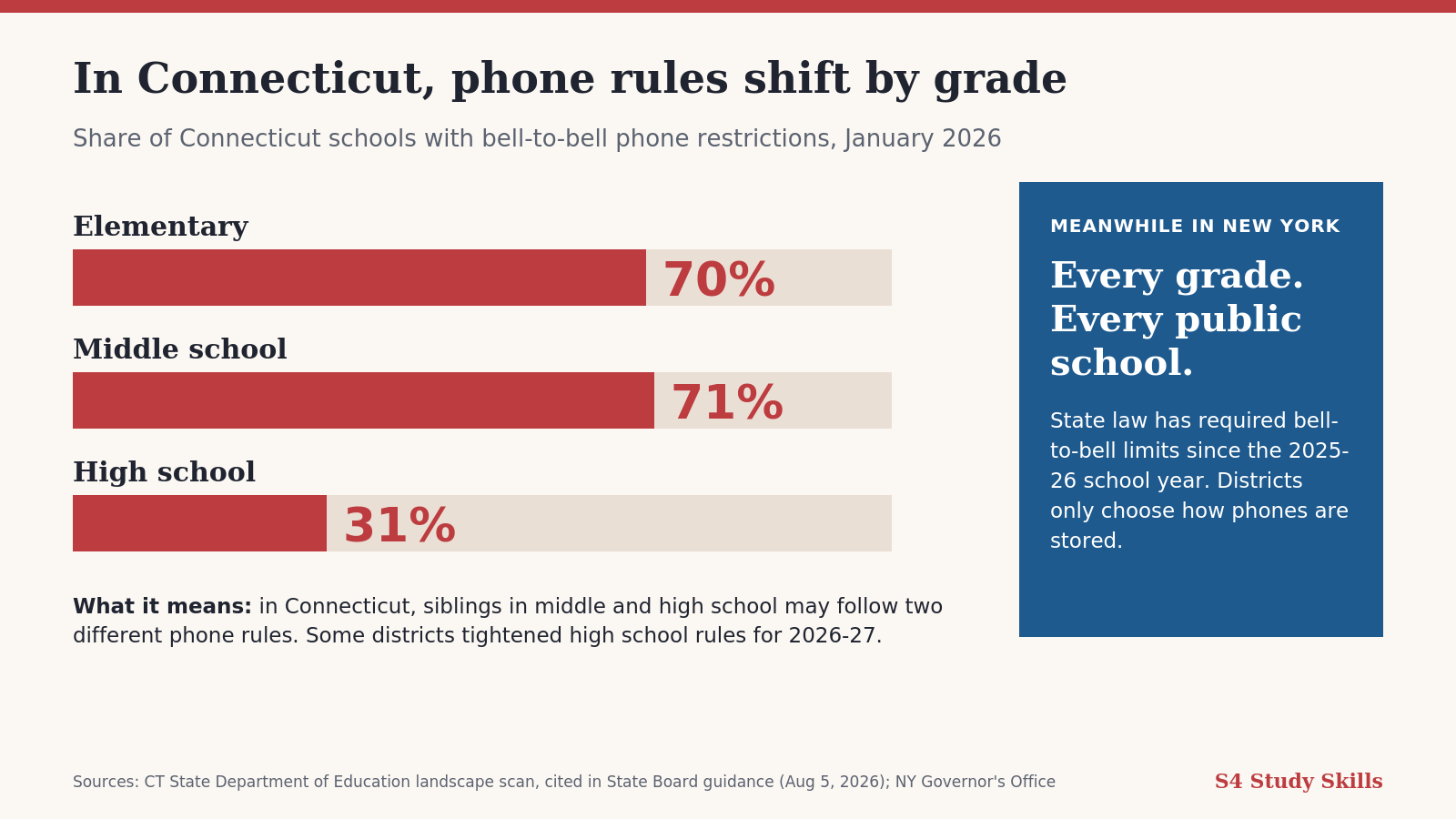
Younger grades moved first. A January 2026 state scan found bell-to-bell restrictions in 70 percent of Connecticut elementary schools and 71 percent of middle schools. Only 31 percent of high schools had them.
The same pattern shows up nationally. RAND found elementary and middle schools were more likely than high schools to use bell-to-bell rules.
If you have one child in middle school and one in high school, you may be living with two different phone rules under one roof.
WHAT FAIRFIELD COUNTY DISTRICTS HAVE PUBLISHED
- Greenwich: The district describes “No Cell Bell to Bell” across its elementary schools, middle schools and Greenwich High School. Its school board voted in June 2026 to extend the full-day rule to the high school for 2026-27.
- Darien: Middle school phones stay off and in lockers all day. At Darien High School, phones for grades 9 through 11 are locked in pouches during school hours, with limited senior use.
- Westport: Staples High School moved to a bell-to-bell rule with lockers in November 2025.
- New Canaan: New Canaan High School became a fully phone-free campus for 2026-27, using locked pouches from 8:00 a.m. to 2:30 p.m.
- Fairfield and Southport: Fairfield Public Schools requires phones to be secured from the first bell until dismissal, with pouches at the high schools and lockers at the middle schools.
Details can change during the year. Your current student handbook is always the final word.
What is New York’s Distraction-Free Schools law?
New York has a statewide requirement, now in its second year. Since the 2025-26 school year, every public school, charter school and BOCES program must prohibit student use of internet-enabled devices from bell to bell. That covers smartphones, tablets and smartwatches during homeroom, lunch, recess, study halls and passing time.
Here is what the law requires:
- Storage: Each district chooses its own method.
- Funding: The state made $13.5 million available for storage.
- Parent contact: Each policy must explain how parents can reach students during the day.
- Public access: Policies must be posted online, in the 12 most common languages spoken in the state.
- Reporting: Starting September 1, 2026, schools must report each year on how the rule is enforced.
You can look up any school’s policy at ny.gov/phonefree.
New York’s lawmakers chose one rule for the whole state. Connecticut’s Senate, for now, left that choice with local boards.
WHAT WESTCHESTER FAMILIES WILL FIND
- Chappaqua: Policy 5031 prohibits internet-enabled device use during the school day on school grounds. Storage differs by level, with pouches at the high school.
- Scarsdale: The district’s board policy on personal electronic devices is posted online. Local coverage reported that it bars use at any time during the school day, including lunch and passing time.
- Armonk: Byram Hills families can find the district’s current policy in the state lookup at ny.gov/phonefree.
PART 3: THE AI GAP
What are states doing about AI in schools?
States are writing AI guidance quickly and binding rules slowly. As of October 2025, AI for Education counted 33 states and Puerto Rico with official AI guidance for K-12 schools. Only a handful have gone further. Ohio, Tennessee, Idaho, Maryland, Oklahoma and Virginia now require districts to adopt an AI policy.
Lawmakers are busy. FutureEd tracked 77 AI-in-education bills across 27 states in the 2026 session. As of July 13, 2026, ten had become law.
Where binding rules exist, they tend to cover the same ground:
- Student data privacy
- Human oversight of AI decisions
- Clear rules for acceptable use
- AI literacy for students
- Protecting the role of teachers
Oklahoma offers a clear example. Its 2026 law requires districts to have written AI policies before the 2027-28 school year. It calls for AI use that is directed by educators with a human in the loop. The law also bars AI from being the main basis for grading or discipline decisions.
Closer to home: Connecticut’s Commission for Educational Technology has published AI guidance. New York State was not on AI for Education’s guidance list at its last update. Neither state is on the list of states that require districts to adopt an AI policy.
Phones vs. AI: the gap in one table
| Phones | AI | |
|---|---|---|
| State action | 42 states, DC and Puerto Rico have laws (NCSL, July 2026) | Guidance is common. Binding rules exist in a handful of states. |
| In schools | Nearly all schools report a phone policy | Only 18% of teachers report formal guidance from school leaders |
| Direction | Largely settled | Wide open |
| Who set the rule for your child | Your state or your district | Often nobody yet |
| Where to look it up | Student handbook or state lookup | Course syllabus, if it says anything |
| Your job at home | Back up the school’s rule | Set the rule yourself |
Why is there still no clear AI rule for your child?
The policy has not reached most classrooms yet. A Gallup and Walton Family Foundation survey of 2,069 public school teachers, taken in early 2026, found only 18 percent had received formal guidance from school leaders on how AI tools should be used. About a third said they had no guidance of any kind.
In practice, AI rules may change from one class to the next. A course syllabus may say more than the district handbook. Both may say nothing at all.
Phone rules were handed to you. The AI rules were not.
PART 4: WHAT THIS MEANS FOR YOU
What should Connecticut and New York parents do this fall?
You have two jobs. First, find out what your own district decided about phones, since that varies a lot in Connecticut. Second, set AI expectations at home, because in most districts nobody else has.
- Read the actual phone policy. For Connecticut schools, check the student handbook or district website. In New York, use the state lookup at ny.gov/phonefree.
- Check the exceptions. If your child has an IEP, a 504 plan or a health plan, ask the team how device use is handled. Do not assume the school rule overrides the plan.
- Ask how to reach your child. Find out the school’s process for family contact during the day.
- Look for AI rules in each syllabus. If a class says nothing, a short email to the teacher can clear it up early.
- Set your family’s AI rules. Decide when AI is allowed for homework, what it can help with, and when your child should tell the teacher they used it.
We made this easier with a free download. The 2026 Parent Guide to School Tech Policy [URL NEEDED: guide-download] puts both states, the phone rules and the AI picture in one place.
Next week, we get specific about AI. Watch for our two-part AI series on September 27.
A phone rule removes one distraction. The skills underneath, like focus, planning and starting homework without a reminder, still need to be built. If your child needs help there, our executive function coaching builds those habits one step at a time. You can also find more strategies in our middle school guide.


Frequently asked questions
How many states have banned cellphones in schools?
Most states have taken some action. NCSL counted 42 states, plus Washington, DC and Puerto Rico, with enacted laws as of July 15, 2026. Those laws differ a lot. The number of states with true bell-to-bell requirements is smaller and depends on how a tracker counts.
What does bell-to-bell actually mean?
Bell-to-bell means from the first bell to the last, including lunch, study hall and passing time. An instructional-time rule is different. It limits phones in class but allows them between classes. People sometimes use the same shorthand for both, so check your own handbook.
Did Connecticut ban phones in schools?
No. A bell-to-bell bill passed the Connecticut House in April 2026, but the Senate never voted on it and it died when the session ended. In August 2026, the State Board of Education adopted guidance that strongly recommends bell-to-bell limits. Districts may follow it or not.
Can my child have a phone at school in Connecticut?
That depends on your district, because there is no statewide rule. A January 2026 state scan found bell-to-bell limits in most elementary and middle schools, but in only 31 percent of high schools. Several districts, including Greenwich and New Canaan, have tightened high school rules for 2026-27. Your student handbook is the final word.
What if my child has an IEP or a 504 plan?
Nearly every state law and district policy includes exceptions for documented learning and health needs. Connecticut’s guidance and New York’s law both name IEPs and 504 plans. If your child uses a device for an accommodation in their plan, talk with the team. Do not assume the school rule overrides the plan.
Do phone bans improve grades?
The evidence is early and mixed. A Florida study found test scores improved in the second year of a ban. Research from England found strict rules alone were not linked to better mental wellbeing. Teens also still report using phones during the day, so enforcement matters as much as the rule.
What are the rules for AI in my child’s school?
Probably fewer than you expect. Most states have AI guidance, but only a handful require districts to adopt an AI policy. A 2026 Gallup survey found only 18 percent of teachers had received formal AI guidance from school leaders. Start with the course syllabus, then ask the teacher.

