

If you’re feeling behind on the whole AI-for-studying conversation, you’re not alone. Most parents we talk to feel caught between two uncomfortable truths: their teens are already using AI tools for homework, and they have no idea if it’s helping or hurting.
Here’s what we know from working with students daily: AI isn’t going away, and pretending it doesn’t exist won’t protect your student. They’ll use it regardless. What matters is whether they use it to build skills or bypass learning entirely.
Rather than debating AI’s place in education, we’re focused on the practical reality: helping you guide your student to use these tools strategically.
AI Can Be a Powerful Study Partner, but Only With the Right Skills
The research is clear: AI tools can accelerate learning when students already possess (or are actively building) executive function skills like self-monitoring, strategic thinking, and metacognition.
Without those underlying skills? AI becomes a crutch that prevents actual learning.
Consider this parallel: AI functions like a calculator for cognition. Just like calculators didn’t eliminate the need to understand math concepts, AI doesn’t eliminate the need for students to develop their own thinking. But students need to know what problem they’re solving before the tool becomes useful.

A Quick Note About School Policies
Before we dive into specific tools and techniques, this is important: your student should check their school’s AI policies. Many schools now have explicit guidelines about when and how AI can be used for assignments. Some allow it for brainstorming and studying but prohibit it for submitted work. Others have blanket bans.
Using AI in violation of school policy, even unknowingly, can have serious academic consequences. Make sure your student understands the boundaries before experimenting with any of these tools.
The AI Study Tools Actually Worth Using
Let’s get practical. Here are the AI tools and techniques that can genuinely support learning when used correctly.
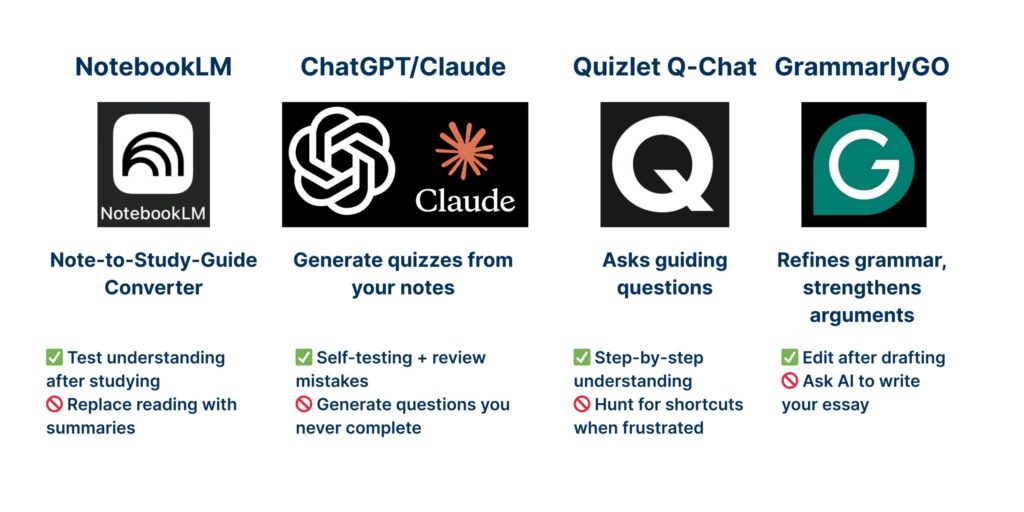
NotebookLM: The Note-to-Study-Guide Converter
What it does: Google’s NotebookLM allows students to upload PDFs, class notes, or textbook chapters. The AI then generates summaries, creates connections between concepts, and can even simulate a podcast-style discussion explaining the material.
When this works: Students who already review their notes regularly and actively engage with material benefit from seeing concepts explained in multiple ways. The tool helps them identify gaps in their understanding and reinforces learning through different modalities.
When it backfires: Students who treat AI summaries as a replacement for reading or note-taking never engage deeply with the material. They consume pre-digested content instead of doing the cognitive work that creates actual learning. This becomes the digital equivalent of only reading SparkNotes: you’ll recognize plot points but miss the deeper themes.
The difference? Students with strong executive function skills use NotebookLM to test their understanding after studying. Students with weak EF skills use it to avoid studying in the first place.
The “Sparring Partner” Technique: AI-Generated Practice Questions
What it does: Students feed their class notes or study materials into ChatGPT or Claude and ask the AI to generate practice questions, quizzes, or problems based on that content.
When this works: This technique is powerful for students who understand that testing themselves is one of the most effective study strategies. They use AI-generated questions to practice retrieval, identify weak spots, and build confidence before the actual exam. Critically, they review their mistakes and understand why they got questions wrong.
When it backfires: Students who compulsively generate questions but never actually complete them or analyze their errors waste time in busy work that feels productive but isn’t. Worse, students might ask the AI to generate questions, then immediately ask it to answer those same questions, creating an illusion of studying with zero actual learning.
Here’s the executive function gap: AI responds to prompts. Students with weak executive function struggle to create the right prompts in the first place. They don’t know what they don’t know, so they can’t effectively direct the AI to target their actual gaps.
This is why many families use AI alongside executive function coaching, not instead of it. A coach helps students identify what to practice and ensures the practice actually translates to learning.
Quizlet Q-Chat: Socratic-Style Tutoring
What it does: Quizlet’s AI tutor uses a Socratic questioning method. Instead of giving direct answers, it asks guiding questions that help students arrive at an understanding of themselves.
When this works: Students who engage honestly with the prompts and think through the questions benefit from this scaffolded approach. It mimics good tutoring by building understanding step-by-step rather than just providing answers.
When it backfires: Students who get frustrated with the questioning and simply ask the AI for direct answers (or switch to a different AI that will provide them) defeat the entire purpose. Without the patience and frustration tolerance required for genuine problem-solving, they’re just cycling through tools looking for the path of least resistance.
GrammarlyGO and Writing Enhancement Tools
What it does: AI writing assistants can help students strengthen arguments, vary sentence structure, check grammar, and identify unclear reasoning in their essays.
When this works: Students who already have a draft, meaning they’ve completed the actual thinking work, can use these tools to refine their writing. The AI becomes an editor that helps them express ideas more clearly, not a substitute for having ideas in the first place.
When it backfires: Students who ask AI to “write an essay about…” or “improve this paragraph” without understanding what makes writing effective learn nothing. They’re outsourcing the cognitive work that develops critical thinking and communication skills.
Here’s the distinction: AI gives answers. Coaching builds judgment. A writing coach helps students understand why certain arguments are stronger, how to structure ideas logically, and when to revise. AI provides mechanical suggestions without building the underlying writing competence.
What AI Actually Can’t Do (And Why Students Still Need You—And Us)
Let’s be clear about AI’s limitations, because this is where human support becomes essential.
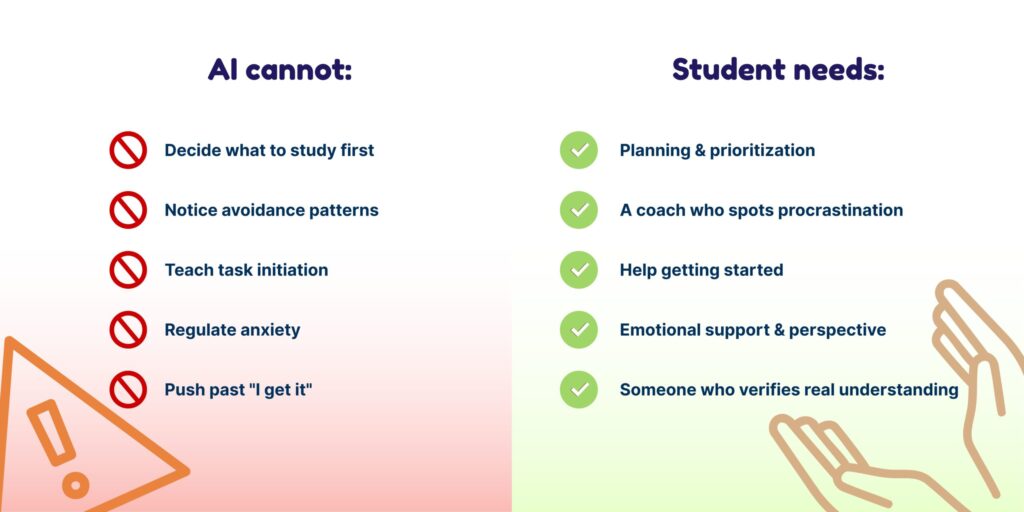
AI cannot decide what to study first. When your student is overwhelmed with three tests and two papers due the same week, AI won’t help them prioritize or build a realistic timeline. That requires executive function skills like planning, time estimation, and self-awareness that coaching develops.
Recognizing avoidance patterns? That’s another gap. If your student is asking AI to explain the same concept repeatedly without ever practicing it themselves, the tool won’t recognize that procrastination and avoidance. A human coach will.
Task initiation remains a human challenge. Getting started is often the hardest part. AI waits passively for prompts. Students with weak initiation skills never prompt it in the first place, or they prompt it in ways that enable avoidance rather than learning.
When stress hijacks your student’s executive function, they need human support to reframe their thinking, break down overwhelming tasks, and maintain perspective. AI can’t provide that emotional co-regulation for anxiety or perfectionism.
Finally, AI accepts everything at face value. Every student has said “yeah, I get it” when they absolutely don’t. Human tutors and coaches recognize that disconnect and push students to genuine understanding. AI accepts the student’s self-assessment without question.
Teaching Responsible AI Use: The Parent’s Role
You don’t need to become an AI expert. Instead, help your student think critically about how they’re using these tools.
Ask better questions:
- “How did using that tool help you understand the concept better?”
- “Can you explain what you learned in your own words?”
- “What would you do differently on the test versus what the AI suggested?”
Look for these red flags:
- Using AI to complete assignments directly rather than support understanding
- Spending more time asking AI for help than attempting problems independently
- Inability to explain concepts without referencing what “the AI said”
- Decreased engagement with the actual course material
Encourage these habits:
- Using AI to generate practice problems, then solving them without AI assistance
- Explaining AI-generated summaries in their own words to verify understanding
- Comparing AI suggestions to their own thinking rather than accepting them uncritically
- Treating AI as one resource among many, not the primary learning source

When Human Coaching Becomes Essential
The distinction matters most here: students who struggle academically often don’t lack access to information. They lack the executive function skills to manage that information effectively. AI gives them even more information without addressing the underlying organizational, planning, and self-monitoring gaps.
At S4, we’re not competing with AI. We’re teaching students how to use it responsibly while building the human skills that make any tool, including AI, actually useful. That means:
Teaching prompt engineering as a skill. Students need to learn how to ask effective questions, identify their actual confusion, and direct AI tools strategically. That’s a teachable skill, but it requires instruction.
Setting guardrails. We help students establish boundaries around AI use that support learning rather than replace it. That might mean using AI only for practice questions, only after completing work independently, or only for specific subjects where they need different explanations.
Building metacognition. The most important skill students need isn’t technological but rather the ability to assess their own understanding accurately and adjust their approach accordingly. AI can’t teach that. Human coaching can.
Frequently Asked Questions
Is using AI for studying the same as cheating?
It depends entirely on how it’s used. Using AI to explain a concept you’re struggling with or generate practice problems is no different than watching a Khan Academy video or working with a study group. Using AI to complete assignments you’re supposed to do independently crosses the line into academic dishonesty.
The key distinction: Are you using AI to build understanding, or to bypass the learning process entirely?
Should I let my student use AI for homework help?
Check your school’s policies first. Assuming AI use is permitted, the answer is: with boundaries. AI should support understanding, not replace thinking. If your student can explain the concept in their own words after using AI, it’s probably supporting learning. If they’re just copying what AI provides without understanding it, that’s a problem.
Will AI make tutoring obsolete?
No, for the same reason calculators didn’t make math teachers obsolete. AI is a tool. Students still need human guidance to use tools effectively, develop executive function skills, manage their learning process, and build genuine competence. AI actually makes coaching more important. Students need help navigating these tools responsibly.
My student is already using AI, and I have no idea what they’re doing. What now?
Start with curiosity, not judgment. Ask them to show you how they’re using it. Have them explain what they’re learning versus what they’re just getting answers to. Then establish some boundaries together about when AI use supports learning versus when it shortcuts it.
If you’re not sure how to guide that conversation, that’s exactly where executive function coaching helps. We work with students to develop their own responsible-use guidelines based on their learning needs.
The Bottom Line: AI Is Infrastructure Now
Fighting AI in education is like fighting calculators in math class. The question was never “if” but “how.”
Your student will use AI. The only question is whether they’ll use it in ways that build their capabilities or undermine them.
That distinction requires executive function skills, metacognition, and honest self-assessment. These are capabilities AI can’t teach, but human coaching can.
At S4 Study Skills, we help students develop the judgment, strategic thinking, and self-management skills that make AI a useful tool rather than a dangerous crutch. In 2026, the most valuable skill becomes knowing when not to.
Ready to help your student navigate AI responsibly while building genuine academic skills? Contact us at 203-307-5455 or info@s4studyskills.com to learn how executive function coaching creates the foundation that makes any learning tool, AI included, actually effective.

