

When scores drop on the Digital SAT, most don’t come from content or knowledge gaps.
They come from pacing errors, working memory overload, and inefficient test strategy inside the Bluebook app. Students who understand the material often underperform because they mismanage time, navigation, or cognitive energy, not because they don’t know their stuff.
If your child has been preparing for months and you’re still worried heading into this week, this post is for you. Here are five Digital SAT mistakes smart students make and what they can do about each one before March 14.
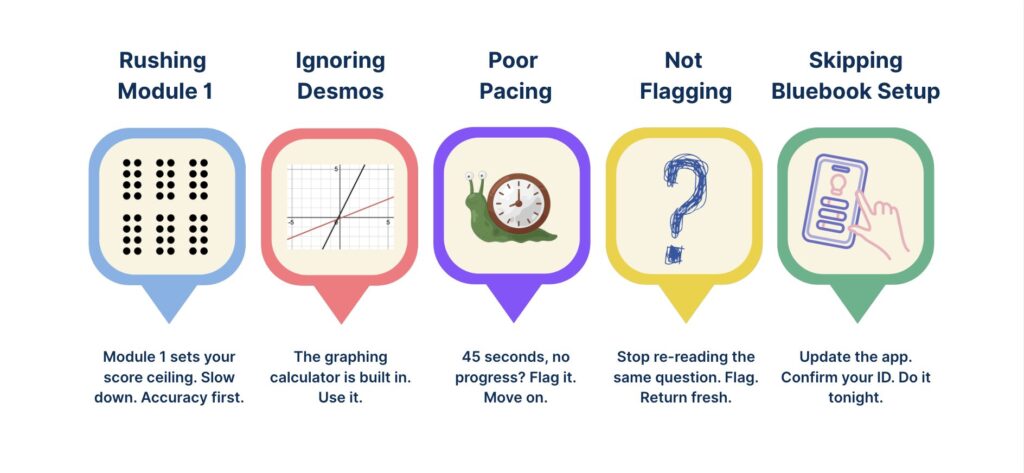
Mistake #1: Not Finishing Module 1 Cleanly
Why Module 1 Accuracy Determines the Score Ceiling
The Digital SAT is adaptive. How your child performs in Module 1 directly determines the difficulty level of Module 2 and that matters more than most students realize. Strong performance in Module 1 opens the door to a harder (and higher-scoring) second module. Careless errors early on can cap score potential before the test is even halfway through.
This is why parents often say: “My child knows this material. Why did they miss easy questions?” The answer is almost always rushing through early questions to save time, or mentally checking out on problems that feel too easy.
How to Fix It Before Saturday
The fix is counterintuitive: tell your student to slow down slightly on the first five questions. A quick double-check on any flagged answer is worth the 30 extra seconds. The goal in Module 1 is clean accuracy on problems they absolutely know, not speed.
Mistake #2: Using Manual Math When Desmos Is Right There
The Built-In Desmos Calculator Is a Competitive Advantage
Bluebook comes with a built-in Desmos graphing calculator, and many students either forget it’s there or don’t know how to use it effectively under time pressure. Desmos can graph systems of equations, find intersections, and work through quadratics visually, tasks that eat up time when done by hand.
Research on cognitive load shows that offloading mental tasks to external tools improves accuracy under time pressure. Students who know how to use Desmos strategically are actually working smarter.
When to Use Desmos and When to Skip It
Desmos is most useful for:
- Systems of equations (graph both lines and find the intersection)
- Quadratic functions (finding zeros, vertex, or direction)
- Visual verification of algebra work when a student isn’t sure about their answer
It’s not the right tool for basic arithmetic or simple one-step problems where setup takes longer than solving. Students who practice with Desmos before test day perform more confidently than those encountering it cold on Saturday morning.
Mistake #3: Time Blindness and Poor Pacing
Why High-Performing Students Run Out of Time
Time management under test conditions is a skill unto itself and a completely different one from managing homework time at the kitchen table.
Both students with and without ADHD can struggle with time perception when stress and cognitive load spike. Under pressure, anxiety consumes working memory, making it harder to think clearly and keep track of the clock.
Here’s something worth knowing: sometimes what looks like test anxiety is actually a pacing problem. The physical feelings can be similar, but the root cause and the fix are different. More on that distinction in a moment.
The 45-Second Rule and Skip-and-Return Strategy
One of the most effective Digital SAT pacing strategies is simple: if a student has spent 45 seconds on a question with no meaningful progress, they flag it and move on. This protects the last five minutes of the section for revisiting flagged questions with fresh working memory.
The instinct to “figure it out” before moving on is strong, especially in high-achieving students. But staying stuck on one hard question is one of the fastest ways to drop points on questions that come later in the section. Practicing this skip-and-return approach before test day helps students build real confidence in the strategy.
Mistake #4: Not Flagging Questions Strategically
Why Students Waste Points on Pride
There’s a certain stubbornness that comes with being a smart student. Walking away from a question that should be solvable feels like giving up. Under time pressure, that mindset costs real points.
Re-reading the same question three times without making progress burns time and working memory. Flagging a question is not a defeat. It’s a tactical decision.
How to Use Bluebook’s Flag Feature Properly
Bluebook’s flag feature is built for exactly this situation. The process:
- Flag immediately when stuck. Don’t debate it. If 45 seconds have passed with no real progress, flag and move on.
- Don’t re-read the same question repeatedly. If the current approach isn’t working, a fresh look after finishing the section will help more than staring at it now.
- Return to flagged questions in the final minutes with full attention. Often, the answer clicks faster the second time around.
Students who practice this system during timed drills internalize it. Students who encounter it for the first time on Saturday tend to resist it.
Mistake #5: Ignoring Test-Day Logistics
Bluebook Exam Setup Checklist
This one catches families off guard more than you’d expect. The Bluebook app must be properly set up before test day. A technical issue Saturday morning is a stressor no student needs. Run through this checklist now:
- Bluebook app installed and updated to the latest version
- Exam preview completed inside the app
- Device fully charged (and charger packed in the bag tonight)
- Valid photo ID confirmed (physical ID required)
- Admission ticket printed or accessible
What to Bring to the SAT in 2026
- Valid government-issued or school photo ID (physical copy)
- Approved calculator if your student prefers their own (Desmos is built into Bluebook, but familiarity matters)
- Device charger
- Snacks and water for the break
- Layered clothing (testing rooms vary widely in temperature)
Test Anxiety vs. Poor Test Strategy: How to Tell the Difference
Parents often wonder whether their child’s test performance reflects anxiety or a skill gap. The distinction matters, because the interventions are different.
It’s Likely Anxiety If Your Student:
- Experiences physical symptoms before the exam (racing heart, stomachache, headaches)
- Has sleep disruption in the days leading up to test day
- Panics before even opening the exam
It’s Likely a Strategy Issue If Your Student:
- Consistently runs out of time
- Leaves questions blank
- Misses problems they definitely know
- Shows strong daily performance but inconsistent test results
Both are real. Both are addressable. But conflating them leads parents to solve the wrong problem, either dismissing genuine anxiety as “just nerves” or focusing on more test prep when the real issue is strategic.
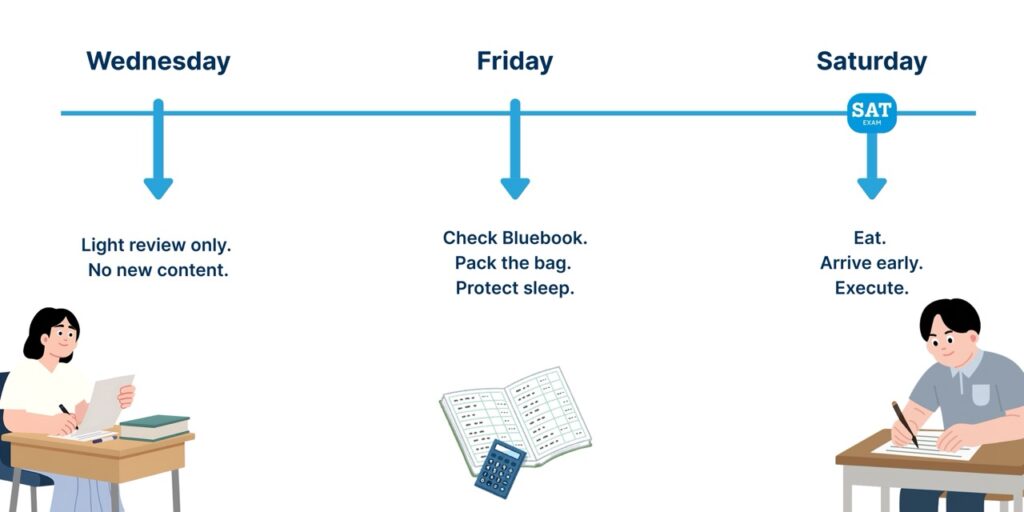
The 72-Hour Digital SAT Plan
3 Days Before (Wednesday)
This is not the time for new content. A short practice session reinforcing pacing and familiar strategies is more useful than cramming. Light retrieval review only; go back over what’s already learned, not what’s not.
1 Day Before (Friday)
Check Bluebook. Do a light warm-up if your student needs it, maybe 10 questions to stay sharp without draining energy. Pack the bag tonight. Most importantly, protect sleep. This is the most valuable thing your student can do Friday night.
Morning Of (Saturday)
Eat a protein-forward breakfast. Arrive early so the environment itself isn’t a stressor. The job on Saturday morning is execution, not preparation. What your student knows, they know. The goal now is staying calm and applying the strategies they’ve practiced.
After March 14 – What to Do Next
How to Analyze a Score Drop
If March 14 doesn’t go the way your student hoped, the first step is understanding why. Was it pacing? Working memory overload? A content gap in a specific domain? The answer shapes the next steps.
When to Consider a May or June Retake
There is time. The May and June SAT dates give students who tested in March a real opportunity to improve with a clearer picture of what to target. Many students perform significantly better on a retake because they understand their patterns and approach the test with a better strategy.
Don’t Let One Test Reveal a Pattern You Could Have Fixed
If March 14 reveals pacing gaps, working memory overload, or strategy breakdowns, those same patterns will show up in AP exams, finals, and eventually in college coursework. The test is often the first time families recognize that something systematic is going on.
At S4 Study Skills, we work with students across Westchester County and Fairfield County to build the executive function skills that make tests (and school) more manageable. Our focus is strategy, not just subject matter. If your student is heading into Saturday feeling underprepared, or if the results next week raise questions you’d like help understanding, we’re here.
Schedule a Post-SAT Strategy Session
Call us at 203-307-5455 or visit successfulstudyskills4students.com
Serving families in Westchester County, NY and Fairfield County, CT.

